The Man Beneath the Mask Does Not Exist: The Psychology of The Tick
Most superhero stories eventually become interested in the person behind the costume. Batman has Bruce Wayne. Superman has Clark Kent. Spider-Man has Peter Parker, overdue bills and the dawning realisation that every decision he makes will somehow ruin Thursday.
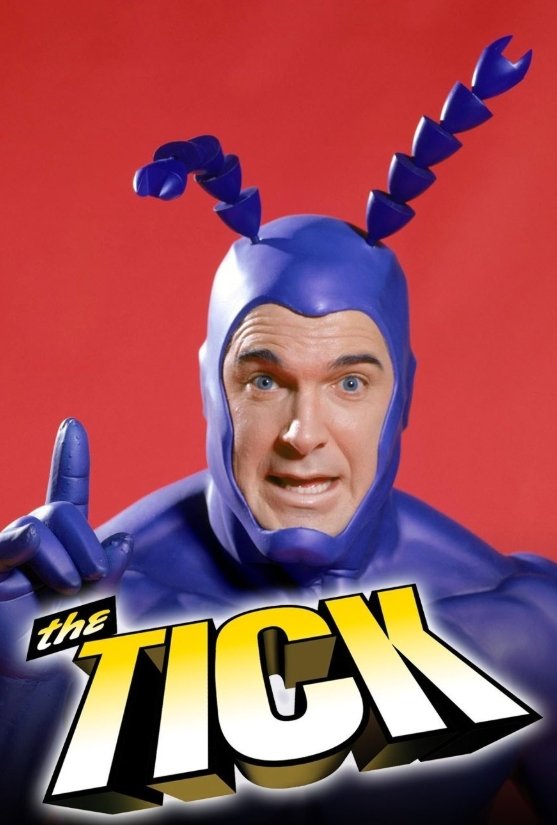
The Tick has The Tick.
There is no ordinary man waiting beneath the blue suit. He has no known civilian name, no remembered childhood, no day job and no apparent desire to take an evening off. He does not become The Tick when danger appears. As far as he knows, he has always been The Tick, and danger is mostly something that happens when he enters a room too quickly.
This is one of the character’s oldest jokes, but the 2001 live-action series turns it into something psychologically worth exploring. Its small scale helps. Rather than surrounding The Tick with constant alien invasions and elaborate supervillains, the series places him in apartments, offices, funerals, relationships and bureaucratic systems. It takes a personality apparently designed for heroic action and makes him deal with ordinary adult life.
He is much less prepared for the second one.
The Tick has almost no self-knowledge, very little social judgement and the practical reasoning of a shopping trolley on a hill. He is also courageous, loyal, optimistic and almost completely free from self-interest. He cannot explain where he came from, but he is never short of views on where justice ought to go next.
The Tick does not remember who he was. He constructs himself entirely from what he believes a hero should be.
A Superhero Without a Backstory
Personal memory provides more than a collection of stories to repeat at family gatherings. It helps create the sense that we are continuous people rather than a sequence of loosely related incidents occupying the same body.
Our memories are organised around current goals, relationships and beliefs about ourselves. They allow us to explain how the person we were became the person we currently claim to be (Conway & Pleydell-Pearce, 2000).
The Tick has almost none of this.
In the 2001 episode “The License,” he discovers that official superhero status requires rather more paperwork than courage. He cannot provide a birth name, former address or any reliable account of his life before arriving in the city. When a woman appears claiming to be his wife, he lacks the autobiographical evidence needed to reject her story. She offers him a past and, briefly, he has little choice but to see whether it fits.
Most people could dismiss a stranger claiming to be their spouse because they possess memories, documents and several relatives who would become extremely vocal about it. The Tick has no such archive. His identity feels obvious from the inside, but it becomes almost impossible to prove once somebody places a form in front of him.
This produces a curious psychological contradiction. The Tick knows very little about himself, but what little he knows is held with extraordinary confidence.
Psychologists use the term self-concept clarity to describe how clearly defined, internally consistent and stable a person’s beliefs about themselves are (Campbell et al., 1996). The Tick’s self-concept is exceptionally clear. There simply is not much in it.
He does not know where he was born, but he knows he is brave. He does not know whether he has a family, but he knows that the innocent require protection. He cannot complete a licence application, but he can transform the experience into a speech about liberty before anyone has found him a pen.
Most people build identity from biography. The Tick does the reverse. He begins with an identity and lets it generate whatever biography the moment requires.
This is why his missing past does not seem to trouble him in the way it might trouble a more conventional character. There is no obvious hole in his life because purpose has filled the available space. He cannot tell you who he used to be, but he knows what he is for.
For The Tick, that appears to be enough.
When the Costume Is the Entire Personality
Superhero identities usually divide the self. The hero has private needs, public responsibilities and at least one person who becomes increasingly suspicious about all the unexplained bruising.
These divisions are psychologically useful because they create competing roles. Bruce Wayne can be a billionaire, orphan, friend and spectacularly difficult employer as well as Batman. Peter Parker can be a student, photographer, nephew and terrible boyfriend as well as Spider-Man. Their heroic identity may dominate their lives, but it is not the only identity available.
The Tick has no such protection.
There is no private Tick who takes off the suit, orders food and wonders whether the evening’s speech about destiny was slightly overdone. He does not appear to want money, career advancement, romance or public recognition. He wants to be heroic, although even that makes his motivation sound more deliberate than it is.
The Tick does not seem to have chosen heroism. Heroism is simply the organising principle around which his mind has formed.
This makes him unusually sincere. He is not performing goodness for an audience. He does not protect people because it supports his brand, repairs his reputation or compensates for the emotional vacancy of his civilian life. He protects people because that is what The Tick does.
There is also something faintly alarming about this.
Healthy identities are usually plural. A person may be a friend, sibling, colleague, parent, neighbour, hobbyist and reluctant participant in a group chat that should have ended three years ago. These roles create tension, but they also stop any single identity from consuming the person completely.
The Tick has only one lens through which to interpret experience. Every situation must eventually become a superhero situation because superheroism is the only language his personality speaks.
A licensing problem becomes a struggle between liberty and bureaucracy. Arthur going on a date becomes a threat to the sacred partnership between hero and sidekick. A funeral becomes a metaphysical crisis because death refuses to behave like a villain.
The Tick is completely authentic, but only because there is almost nothing underneath the performance.
The man beneath the mask does not exist. The mask has become the man.
Morality Without the Usual Negotiation
The Tick’s simplicity is easiest to mistake for stupidity. It often is stupidity, but not only that.
Moral identity describes the extent to which qualities such as fairness, courage and compassion are central to a person’s understanding of themselves. For some people, moral traits are important ideals. For others, they are woven into the basic answer to the question “What kind of person am I?” (Aquino & Reed, 2002).
For The Tick, that answer has swallowed almost everything else.
Courage, loyalty and protection of the vulnerable are not values he balances against comfort, reputation or personal gain. They are the central contents of his identity. He does not need to persuade himself to act morally because there is no competing self making a particularly strong case for staying home.
The other heroes in the 2001 series make this clearer by comparison.
Batmanuel wants the costume, attention, mystique and sexual opportunities associated with superheroism. Heroism is not only a moral role. It is a lifestyle package, preferably photographed from his better side.
Captain Liberty is genuinely committed to helping people, but her heroism is tangled with professional status, recognition and resentment. She wants to do good, but she would also like somebody to notice that she is doing it and perhaps update the rankings accordingly.
Arthur is trying to make heroism part of his identity while several older identities pull him backwards. He has been an accountant, a dutiful family member and a nervous man who understands that being hit with furniture is generally undesirable. Heroism is not automatic for Arthur. It is a decision he must keep making.
This arguably makes Arthur’s courage more psychologically impressive than The Tick’s. The Tick rarely seems able to imagine himself as anything other than brave. Arthur can imagine retreat in exquisite detail and goes forward anyway.
The Tick’s morality is simpler, but it is not necessarily shallower. His lack of complexity removes many of the excuses through which more sophisticated people negotiate themselves away from responsibility.
He does not ask whether intervening will damage his career, embarrass him or qualify as somebody else’s problem. He does not pause to ensure that his values are being expressed in the most strategically useful way. If an innocent person needs help, the discussion has already concluded.
His moral reasoning is often dreadful. His moral direction is remarkably consistent.
The series does not ask us to admire his understanding of the world. It asks us to notice that, beneath the broken metaphors and property damage, he very rarely loses sight of what power is supposed to be for.
The Psychological Benefits of Being Completely Wrong
The Tick is almost physically invulnerable, but his more impressive power may be psychological.
He is extraordinarily difficult to embarrass.
Other people can mock him, reject him or explain that he has completely misunderstood what is happening. His confidence bends briefly and then returns wearing a slightly different metaphor. A social failure becomes evidence that the path of justice is lonely. A bureaucratic inconvenience becomes another battle in the eternal war between freedom and filing cabinets.
Research on positive illusions suggests that mildly favourable distortions of the self and future may sometimes support motivation, persistence and well-being. The idea remains disputed, particularly when optimism becomes detached from reality or begins creating problems for other people, but perfect accuracy is not always psychologically useful either (Colvin & Block, 1994; Taylor & Brown, 1988).
The Tick is what happens when the word “mildly” is removed from this argument.
He assumes that he is capable, righteous and destined to prevail before he properly understands the situation. In most people, this would produce a series of painful lessons. The Tick lives in a body that can absorb the lessons without retaining any of them.
His invulnerability protects his confidence from correction.
The Tick behaves as though he cannot be defeated, and his physical durability ensures that he rarely receives decisive evidence to the contrary. Because he survives, he does not become cautious. Because he does not become cautious, every survival looks like confirmation that charging forwards was the correct approach.
He can afford limitless self-belief because the universe has removed many of the ordinary costs of being wrong.
This would make him unbearable if his confidence existed only for his own benefit. Instead, it becomes something Arthur can borrow.
Arthur expects embarrassment, failure and injury. The Tick simply assumes that Arthur is heroic. He does not provide carefully measured reassurance or a balanced list of Arthur’s strengths. He behaves as though Arthur’s courage is already an established fact.
For someone whose family and former employer see his new life as ridiculous, this complete lack of doubt is powerful. The Tick offers Arthur access to a version of himself that anxiety would otherwise keep permanently theoretical.
The Tick believes in Arthur before Arthur has assembled enough evidence to believe in himself.
His most useful distortion may not be the belief that he personally is a great hero. It is the assumption that heroism is already present in the people he loves and merely requires louder encouragement.
Arthur Is Not the Sensible One
Arthur is often described as The Tick’s straight man, which is accurate in the technical sense and misleading in almost every other one.
He is more sensible than The Tick, but this is not an especially competitive field.
Arthur is anxious, insecure and deeply invested in proving that abandoning accounting for a moth suit was not a nervous breakdown with wings. He brings practical judgement to the partnership, but he also needs The Tick because his own judgement has a habit of becoming endless hesitation.
The relationship works because each supplies psychological functions the other lacks.
Research on transactive memory describes the way people in close relationships can develop shared systems for storing and accessing knowledge. One person does not need to know everything because they know what the other person remembers and when to rely on them (Wegner et al., 1991).
The Tick and Arthur divide more than memory. They divide the basic labour of being a functional person.
Arthur provides inhibition, planning and awareness of social consequences. He notices manipulation, explains institutions and recognises when The Tick’s interpretation of events has wandered off without leaving a forwarding address.
The Tick provides momentum, confidence and permission to act before every possible outcome has been examined.
The Tick has agency without enough restraint. Arthur has restraint without enough agency.
The Tick gets them through the door. Arthur checks whether it was the correct door.
Together, they produce one approximately competent superhero.
This is why Arthur is not merely standing outside the joke and commenting on it. He is part of the system that allows The Tick’s heroism to work. The Tick’s moral certainty is useful because Arthur directs it towards actual human problems rather than whichever object currently looks suspicious.
The episode “Couples” makes this particularly clear. After watching the relationship between Fiery Blaze and Friendly Fire, The Tick adopts the idea that the hero commands and the sidekick obeys. Arthur is reduced from partner to subordinate, and the relationship quickly begins to fail.
The Tick thinks he has learned how superhero partnerships are supposed to work. In reality, he has abandoned the very thing that makes his own partnership functional.
Arthur is not an accessory to The Tick’s heroism. He is part of its cognitive structure.
He also protects The Tick from the darker possibilities of absolute certainty. Moral conviction without context can become self-righteous, controlling or destructive. Arthur translates The Tick’s grand commitment to justice into responses suited to the people standing in front of them.
The Tick makes action possible. Arthur makes it less likely that the action will involve throwing the wrong person through a wall.
There is, of course, another reading of this relationship, and the 2001 series hardly hides it. The Tick and Arthur live together, become jealous when other attachments intrude, negotiate intimacy and personal space, and repeatedly behave like an emotionally mismatched couple who have replaced romantic language with superhero terminology. At times, the series plays less like a traditional superhero parody than a queer romantic comedy that was never permitted to state its premise openly.
That interpretation is not wrong. In fact, it is often the most obvious reading available. The Tick and Arthur have the structure of a couple, even when the script insists on calling them hero and sidekick. Their conflicts concern commitment, independence, attention and the fear of being replaced. Other superhero partnerships are also presented as distorted relationships, particularly in “Couples,” where Fiery Blaze and Friendly Fire resemble a deeply unhealthy marriage with capes.
The queer romantic comedy reading sees the subtext clearly. It may simply stop reading a little too soon.
Arthur and The Tick are not only two men whose relationship exceeds the language available to describe it. They are also two incomplete identities using one another to become functional. Their intimacy is psychological as well as domestic. Each supplies capacities the other cannot reliably produce alone. Whether the relationship is read as friendship, partnership, coded romance or some unstable mixture of all three, its importance comes from the same place: neither man becomes fully himself in isolation.
Ordinary Life Is the Real Supervillain
The 2001 series understands that The Tick is least interesting when everything around him behaves like a superhero story.
Give him a visible villain, an innocent victim and a direction in which to run, and he is almost perfectly adapted. His lack of self-doubt becomes decisiveness. His simplistic morality becomes focus. His poor risk assessment becomes largely irrelevant because very few objects can hurt him.
The real test begins when there is nobody obvious to punch.
In “The Funeral,” The Tick struggles with the death of the supposedly Immortal superhero. Mortality does not fit his understanding of heroism. Heroes arrive, fight evil and continue. Death introduces an ending that cannot be defeated, arrested or converted into a triumphant final blow.
In “Arthur Needs Space,” Arthur’s romantic life requires The Tick to understand privacy, intimacy and boundaries. He struggles because closeness to Arthur feels like an uncomplicated good. If closeness is good, more closeness should be better. The possibility that loyalty may occasionally require leaving the room is psychologically alien to him.
“The License” confronts him with a system that does not care whether he is sincere. The authorities require documents, dates and a traceable personal history. The Tick offers strength, purpose and a series of statements about freedom. None of these fit neatly into the boxes provided.
These episodes reveal that The Tick’s mind is not broadly effective. It is highly effective in one particular moral environment.
When the problem is clear, he is almost unstoppable. When the problem contains mixed motives, competing needs or administrative procedure, the same qualities become social incompetence.
This is where the small scale of the 2001 series becomes one of its strengths. The limited action does not merely reflect the practical realities of early-2000s television. It places a grand heroic archetype in situations too mundane to support him.
A supervillain confirms The Tick’s identity. Ordinary adulthood exposes how little exists beyond it.
The Tick can survive explosions. He is considerably less prepared for Arthur having plans without him.
Arthur, Interrupted and the Life You Were Supposed to Have
“Arthur, Interrupted” shifts the focus onto Arthur’s identity. When he tells his family that he has become a superhero, they interpret it as evidence of mental illness and arrange an intervention. He is taken to a psychiatric institution and treated for superhero delusions, despite living in a world where superheroes plainly exist.
The episode is not a serious account of psychiatric care, nor should it be treated as one. Its satire does raise a useful question about the way normality is socially enforced.
Arthur’s family is not responding only to whether his story is plausible. They are responding to his departure from the life they recognise.
Arthur was an accountant. Accountants are expected to remain accountants, or at least to undergo a respectable midlife crisis involving expensive cycling equipment. They are not expected to wear moth suits and fight Soviet robots.
His superhero identity is treated as evidence that something has gone wrong because it makes him socially unrecognisable. His family already has a settled account of who Arthur is. His attempt to revise that account is interpreted as a loss of reality rather than an act of reinvention.
This does not mean that mental illness is simply unconventionality with medical paperwork. Unusual beliefs can cause genuine distress, impairment and danger. The sharper point is that difference, dysfunction and delusion are not interchangeable.
Whether a belief is irrational depends partly on the world in which the person lives. In Arthur’s world, superheroes exist. The family’s explanation appears reasonable only because it describes the safer world they would prefer to inhabit.
The disagreement is also about where identity comes from.
Arthur’s family believes his past should determine his future. He was an accountant, therefore becoming a superhero represents a break with the real Arthur.
The Tick sees identity as something built through action. Arthur becomes a hero by repeatedly behaving heroically, even while frightened, awkward and dressed in a way that does not inspire immediate confidence.
The Tick has no remembered past and therefore cannot be trapped by it. Arthur has a past and must persuade everyone, including himself, that it does not own him.
This may be one reason The Tick’s belief is so important. He does not know enough about Arthur’s previous life to decide what Arthur is supposed to remain. He sees only what Arthur is trying to become.
The Speeches Are Doing More Than Filling Time
The Tick’s speeches sound like heroic declarations assembled from fragments of philosophy, breakfast and poorly understood wildlife. They are also the main way he creates psychological coherence.
Narrative identity research examines how people construct stories about their lives to produce continuity, meaning and agency. We understand ourselves partly by connecting past events to the person we believe we have become (Adler, 2012; D’Argembeau et al., 2012).
The Tick cannot easily do this. He has almost no past available for interpretation.
Instead, he narrates himself forwards.
His speeches take an unclear present and turn it into a moral future. He begins confused, invokes destiny, injures a metaphor and emerges with a plan. The reasoning is usually poor, but the psychological result is effective.
The speech transforms uncertainty into purpose. It reassures Arthur, restores The Tick’s sense of agency and reminds him what sort of person he is supposed to be.
He has narrative identity without much personal narrative. He does not explain the present through what happened to him. He explains it through the heroic conclusion towards which he assumes the universe is moving.
The speeches are not reports of his thoughts. They are machines for producing certainty.
Patrick Warburton’s performance makes this work. He never delivers the dialogue as though The Tick knows he is funny. Every broken metaphor is spoken with the confidence of a man who believes the universe has selected him to reveal an eternal truth, even when the truth has become entangled with cutlery.
The language fails logically but succeeds emotionally.
The Tick may not know what he is saying, but by the end of the speech he usually knows what he is doing.
The Tick Beyond 2001
The 2001 series provides the clearest version of this psychological argument, but the same basic tension runs through the character’s other incarnations.
The original comic connects The Tick more openly with insanity and begins with him leaving a psychiatric institution. The animated series expands the absurdity outwards, creating a world in which almost every hero and villain represents some damaged piece of comic-book logic.
The later Amazon series places more of the explicit psychological conflict inside Arthur. That version of Arthur is shaped by trauma, anxiety and his obsession with The Terror. The Tick becomes something closer to a protective ideal, a huge blue embodiment of courage that arrives when Arthur is finally prepared to stop hiding from his own life.
Each version rearranges the same ingredients.
The comic asks whether complete heroic conviction can be distinguished from madness.
The animated series asks what happens when superhero symbolism becomes the operating system of an entire world.
The Amazon series asks whether belief in heroism can help a traumatised person recover agency.
The 2001 series asks what happens when a pure heroic archetype has to share an apartment.
Across them all, The Tick’s missing origin remains important. He is less a conventional person than a heroic principle that has somehow become ambulatory. His costume, speeches and moral certainty do not express a hidden inner life. They are the inner life.
This is also why The Tick feels warmer than many superhero parodies. It mocks the costumes, posturing, masculine certainty and remarkable amount of urban damage involved in saving the city. It does not suggest that courage or kindness are secretly foolish.
The Tick’s performance of heroism is ridiculous. His desire to protect people is genuine.
He parodies superheroes by taking their moral claims too seriously and then placing those claims in situations far too small to contain them.
Much modern superhero satire reveals that the powerful hero is really a narcissist, fascist, corporate product or traumatised weapon. The Tick offers a less fashionable possibility.
Heroism may be psychologically absurd without being morally fraudulent.
What The Tick Is For
The Tick is not psychologically healthy in any ordinary sense.
He has little autobiographical continuity, almost no private identity and a limited ability to revise his conclusions. His confidence is protected by physical invulnerability. His practical functioning depends heavily on Arthur. His moral framework begins to wobble whenever a problem cannot be divided into good, evil and something available to punch.
He also possesses qualities that more psychologically sophisticated characters struggle to maintain.
He is loyal without calculation. Courageous without concern for status. Optimistic without waiting for proof that optimism is sensible. He does not mistake kindness for weakness or sincerity for embarrassment. He believes that power creates an obligation to help, and nobody has successfully educated him out of it.
The Tick is psychologically incomplete but morally certain.
He has almost no idea who he is in the autobiographical sense, but complete confidence about what he is for.
Arthur provides the missing complexity. He brings memory, anxiety, context and the recognition that good intentions do not guarantee good outcomes. The Tick gives Arthur something equally valuable: belief untouched by his previous failures, family expectations or fear.
Neither is a particularly adequate hero alone.
Together they create a relationship in which certainty is moderated by judgement and fear is converted into action. The Tick gives Arthur permission to become more than his past. Arthur gives The Tick enough contact with reality to make his convictions useful.
The central joke is not that a foolish man mistakenly believes he is a great hero.
It is that the belief repeatedly helps him become one.
There is no ordinary man beneath The Tick’s mask. There is only the role, the purpose and the enormous blue certainty that somewhere nearby, destiny is probably being inconvenienced by evil.
Arthur, sensibly, checks the address.
References
Adler, J. M. (2012). Living into the story: Agency and coherence in a longitudinal study of narrative identity development and mental health over the course of psychotherapy. Journal of Personality and Social Psychology, 102(2), 367–389. https://doi.org/10.1037/a0025289
Aquino, K., & Reed, A., II. (2002). The self-importance of moral identity. Journal of Personality and Social Psychology, 83(6), 1423–1440. https://doi.org/10.1037/0022-3514.83.6.1423
Campbell, J. D., Trapnell, P. D., Heine, S. J., Katz, I. M., Lavallee, L. F., & Lehman, D. R. (1996). Self-concept clarity: Measurement, personality correlates, and cultural boundaries. Journal of Personality and Social Psychology, 70(1), 141–156. https://doi.org/10.1037/0022-3514.70.1.141
Colvin, C. R., & Block, J. (1994). Do positive illusions foster mental health? An examination of the Taylor and Brown formulation. Psychological Bulletin, 116(1), 3–20. https://doi.org/10.1037/0033-2909.116.1.3
Conway, M. A., & Pleydell-Pearce, C. W. (2000). The construction of autobiographical memories in the self-memory system. Psychological Review, 107(2), 261–288. https://doi.org/10.1037/0033-295X.107.2.261
D’Argembeau, A., Lardi, C., & Van der Linden, M. (2012). Self-defining future projections: Exploring the identity function of thinking about the future. Memory, 20(2), 110–120. https://doi.org/10.1080/09658211.2011.647697
Edlund, B. (Creator). (2001–2002). The Tick [TV series]. Columbia TriStar Television.
Taylor, S. E., & Brown, J. D. (1988). Illusion and well-being: A social psychological perspective on mental health. Psychological Bulletin, 103(2), 193–210. https://doi.org/10.1037/0033-2909.103.2.193
Wegner, D. M., Erber, R., & Raymond, P. (1991). Transactive memory in close relationships. Journal of Personality and Social Psychology, 61(6), 923–929. https://doi.org/10.1037/0022-3514.61.6.923
Table of Contents