742 Evergreen Terrace Is a Memory: Why The Simpsons’ House Never Stays the Same
When I remember the house I lived in until I was six, I can still see the small green sitting room where I used to eat grilled cheese.
It feels vivid enough to walk through.
On one side, there are double doors leading into the garden. In the other direction, the room opens into an enormous drawing room: grand, cavernous and far larger than anything a normal family home should reasonably have contained.
The problem is that none of this appears to be true.
The doors were not where I remember them. The rooms did not connect in that way. Most confusingly, the enormous drawing room may not have existed at all.
It is not simply that I have forgotten the correct layout. My mind seems to have constructed a different house: one assembled from remembered colours, meals, routes, feelings and spaces, then arranged into an architecture that makes emotional sense while making very little structural sense.
Which may explain why I find the Simpson family home so familiar.
The house that refuses to be mapped
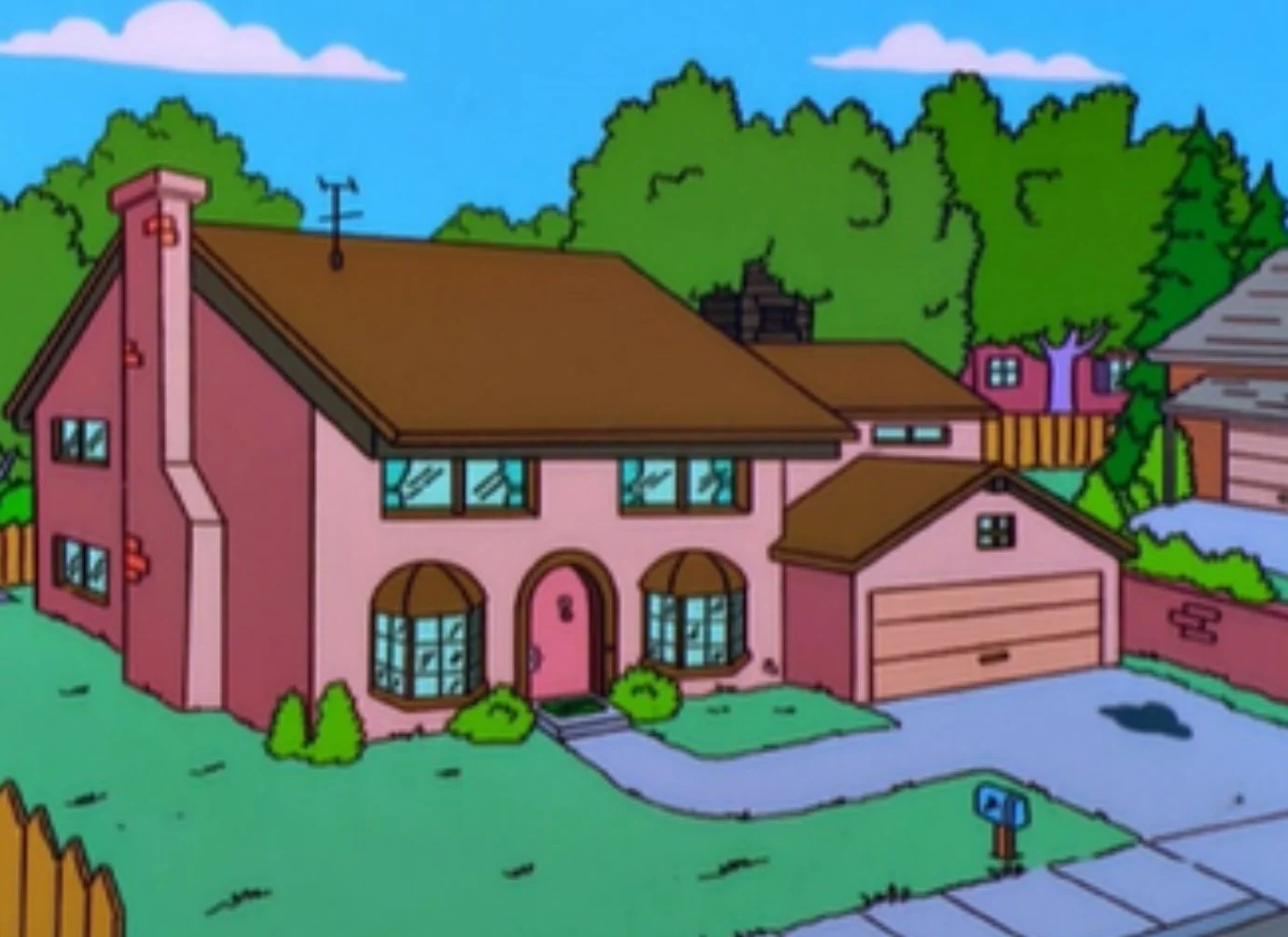
Anyone who has watched enough of The Simpsons feels as though they knows 742 Evergreen Terrace.
There is the living room with its sofa, television and crooked picture. Behind it sits the familiar staircase. The kitchen lies somewhere nearby. There is a dining room, a garage, a basement, a garden, bedrooms upstairs and a treehouse positioned conveniently within Bart’s reach.
We know this house.
Except that we do not.
Attempts to draw a definitive floor plan of the Simpson home tend to reveal how unstable it actually is. Doors move. Corridors appear. Windows face directions that should be impossible. Rooms grow, shrink or vanish. The garage connects differently depending on the episode. Spaces exist when required and disappear when they are no longer useful.
The obvious explanation is that The Simpsons is a cartoon.
The house changes because television production values story clarity over architectural consistency. A door is placed where Homer needs to enter. A window faces the treehouse because Bart needs to climb through it. A spare room materialises because that week’s plot needs somewhere to put a guest, a secret or an unusually dangerous household object.
There is no reason to assume anything more elaborate is happening.
But what if there is another way to look at it?
Not as evidence of a hidden conspiracy or carefully planted fan theory, but as a useful psychological metaphor.
What if 742 Evergreen Terrace does not behave like a physical house because it behaves like a remembered one?
It makes perfect sense if you imagine each episode as a family memory being retold down through the generations, adapting each time it is shared.
We remember what happened, not where the walls were
Memory is often spoken about as though it were a recording.
We “play back” an event. We “retrieve” a detail. We imagine some internal archive in which our experiences sit intact, waiting to be opened.
But remembering is much closer to reconstruction.
We retain fragments: a colour, a face, a smell, an emotional reaction, the general sequence of an event. When we remember, the mind rebuilds the experience from these fragments, using expectations and later knowledge to fill the gaps.
This reconstruction can feel completely convincing even when parts of it are wrong.
A remembered childhood house may therefore preserve the places that mattered without preserving their actual geometry. You remember the room where you ate. The doorway you ran through. The garden you escaped into. The frightening staircase. The cupboard where something was hidden.
You may not remember the measurements, angles or exact relationships between them.
The house survives as a collection of meaningful locations connected by narrative rather than bricks.
That may be what happened to my green sitting room. The grilled cheese remains because the meal mattered. The garden remains because it represented the world beyond the room. The enormous drawing room remains because, from the scale of a small child, some adjoining space felt impossibly vast.
The mind has preserved the experience while inventing the architecture.
The memory is factually unreliable but psychologically faithful.
An emotional floor plan
The Simpson house may be understood in much the same way.
Its important spaces are not defined by dimensions. They are defined by function.
The sofa is where the family gathers. The kitchen is where ordinary domestic life happens. The dining table is where conversations become arguments. Bart’s bedroom is a launchpad for escape, rebellion and badly considered plans. Lisa’s room is a refuge for thought, music and disappointment. The garage belongs to Homer’s projects, ambitions and failures.
These locations remain stable as emotional ideas even when their physical positions change.
The house therefore has something like an emotional floor plan.
We know where everything belongs in the story, even when we could not draw where it belongs on paper.
A corridor can vanish because nobody remembers the corridor. They remember leaving the kitchen and entering the living room. A room can move because its relationship to the event matters more than its relationship to the foundations.
The architecture bends around the story in the same way remembered places bend around the event being recalled.
This does not mean that the writers secretly intended every continuity error as an exploration of autobiographical memory. Almost certainly, they did not.
But sometimes a long-running work accidentally begins to resemble the processes through which culture remembers it.
Springfield’s permanently moving past
The same idea may also offer a more interesting way of thinking about The Simpsons’ famously floating timeline.
Bart is always roughly ten. Lisa is always roughly eight. Maggie is always a baby. Homer and Marge remain middle-aged while decades pass around them.
The world updates, but the family does not.
Earlier episodes placed Homer and Marge’s youth in one historical period. Later stories moved it forward. Cultural references change. Technologies appear. Celebrities age, disappear or die while the residents of Springfield continue as though nothing fundamental has happened.
Again, the ordinary explanation is simple: the programme needs to remain contemporary.
But through the lens of reconstructive memory, Springfield’s changing past begins to resemble the way family stories are repeatedly translated.
Homer and Marge’s youth may not belong to a specific decade. It belongs to the more flexible category of “when Mum and Dad were young”.
For one generation of viewers, that means the 1960s or 1970s. For another, it means the 1990s. Eventually, it may mean a period in which the internet, mobile phones and streaming already existed.
The emotional relationship stays the same while the cultural furniture changes.
Perhaps Springfield is not continually moving forward through time.
Perhaps the present from which Springfield is being retold keeps moving forward.
How stories quietly modernise themselves
Families rarely retell old stories with perfect historical fidelity.
Details are dropped because nobody remembers them. Old objects are replaced with understandable equivalents. Long explanations are compressed. Outdated language is quietly removed.
Someone says, “Your grandfather called us,” even though the original event involved a landline, a neighbour taking a message and someone waiting three hours to call back. The function of the event is preserved while the obsolete mechanics fall away.
Language changes in the same way.
Descriptions, labels and expressions that were once common may later sound offensive, racist, sexist or simply incomprehensible. A modern retelling often replaces them with terms the current audience will accept and understand.
That does not mean the past actually used present-day language. It means the story has been filtered through the morality and vocabulary of the person now telling it.
There is something slightly uncomfortable in that process.
Updating language can prevent unnecessary harm and stop old prejudices being casually reproduced. But it can also sanitise history. If every old story is translated into contemporary decency, we may forget how people actually spoke and what their language revealed.
The Simpsons also updates itself morally and culturally. Certain stereotypes become less acceptable. Some characters are reframed. Old jokes are treated differently once the assumptions beneath them become more visible.
Seen as television production, this is simply adaptation to changing audiences.
Seen as memory, it resembles a family retelling its own past using the language it can now live with.
The room that memory built
The most interesting part of my childhood memory is not that I placed a door incorrectly.
It is that I seem to remember an entire drawing room that was not there.
Memory does not merely delete. It also creates.
It blends rooms from different places. It borrows details from photographs. It enlarges spaces that seemed enormous to a child. It gives names to rooms that were never called those names at the time. It converts a sensation—grandeur, fear, warmth, distance—into physical structure.
The invented room may therefore tell us something true, even if the room itself was false.
Perhaps there was a real space that felt enormous. Perhaps two different houses have merged. Perhaps my later understanding of what a drawing room should be has attached itself to an early visual fragment.
Or perhaps the mind simply needed a room large enough to hold the feeling.
That may be why the Simpson house can contain so many impossible spaces. The house expands to hold the memory currently being told.
A previously unseen room appears because the family needs to remember that something happened there. A basement grows because a story requires hidden machinery, forgotten possessions or a relative who has somehow gone unnoticed. A cupboard becomes large enough for a plot.
These spaces are not architecturally credible.
But memories often are not.
What psychology tells us about impossible memories
It is tempting to call memories like my impossible drawing room “false memories”.
That is not entirely wrong, but it can be misleading.
The phrase often suggests that a person has invented a complete event that never happened. In reality, much ordinary remembering involves a mixture of accurate fragments, missing information, later knowledge and unconscious reconstruction. A memory can contain something false without the entire memory being fabricated.
I probably did eat grilled cheese in a small green sitting room. There probably was a route from that part of the house toward the garden. There may have been another room nearby that appeared enormous from the perspective of a small child.
The error may lie in how those fragments have been assembled.
Psychologists have long argued that memory is reconstructive. We do not retrieve a perfect recording of an earlier experience. We rebuild it using whatever remains, along with our current understanding of what normally belongs in that kind of scene.
This is where schemas become important.
A schema is a general mental framework for how something is expected to work. We have schemas for restaurants, classrooms, weddings, hospitals and family homes. A house is expected to contain connected rooms, doors, corridors, windows and recognisable routes between important places.
When parts of a memory are missing, the mind can use this general knowledge to create a coherent whole.
I remember the green sitting room. I remember the garden. I remember a larger space. The mind does not necessarily leave these as three disconnected fragments. It constructs a plausible route between them.
The problem is that plausibility is not the same as accuracy.
A door may appear because a door is needed to explain how one remembered place led to another. A room may become adjacent because the events associated with those rooms belong together in the story. Several spaces may be compressed into one. A room from another house may be inserted without announcing where it came from.
This is partly a problem of source monitoring.
Source monitoring is the process through which we decide where a memory came from. Did we experience something directly? Did someone tell us about it? Did we see it in a photograph? Did we imagine it repeatedly? Did it happen in this house or another one?
Usually, the mind makes these judgements quietly and successfully. Sometimes, however, the content of a memory survives while its source becomes blurred.
A photograph can become something we believe we remember seeing with our own eyes. A parent’s story can become a first-person recollection. Two childhood homes can gradually share the same staircase, garden or spare room. An imagined reconstruction can become more familiar each time we revisit it, until that familiarity begins to feel like evidence.
Repeated imagination can strengthen this effect. Each time we picture a scene, we are not simply inspecting the original memory. We are also creating a new version of it. That reconstruction may then become part of what we remember the next time.
Memory is therefore not only altered by forgetting. It can be altered by remembering.
The more often I return to the green room, the more opportunities I have to rehearse the wrong doors and reinforce the impossible drawing room. Vividness may increase even as accuracy decreases.
This matters because confidence and accuracy are not the same thing.
A memory can feel detailed, fluent and emotionally certain while containing substantial errors. The ease with which an image comes to mind may tell us how often we have reconstructed it, not how faithfully it represents the original event.
Childhood memories are especially vulnerable to this process.
A young child does not perceive or organise space like an adult. Rooms appear larger. Distances feel longer. Certain objects dominate attention while the wider layout goes unnoticed. A child may understand a house as a series of destinations rather than as a continuous three-dimensional structure.
The remembered house may therefore preserve the child’s experience of moving through it, not the adult reality of its architecture.
The garden was where I went outside. The sitting room was where I ate. The drawing room was the enormous place beyond. The emotional sequence may be intact even if the physical route is not.
This provides a useful way of thinking about 742 Evergreen Terrace.
The Simpson house may contain stable fragments surrounded by unstable reconstruction.
The sofa is remembered. The staircase is remembered. The kitchen, garden, garage and bedrooms are remembered. Their precise relationships are rebuilt each time the story requires them.
One episode remembers Bart leaving his bedroom and reaching the treehouse. Another remembers Homer moving from the garage into the kitchen. A third remembers the family discovering a room that has apparently always existed.
Each individual sequence feels coherent because the mind is good at accepting locally plausible space. The contradiction appears only when we try to combine every episode into a single objective map.
That is exactly where remembered geography often fails.
A childhood home can make perfect sense when recalled one event at a time. The green room leads to the garden because that is how one memory unfolds. It leads to the enormous drawing room because that is how another memory unfolds.
Only when someone asks for the floor plan do we discover that the memories cannot all occupy the same building.
Perhaps this is why the Simpson house feels so recognisable despite being impossible.
We do not know it as architects.
We know it in the same way we know the homes of our own childhoods: as a collection of emotionally important places that remain vivid long after the walls between them have begun to move.
No secret narrator required
It is tempting to ask who might be remembering all of this.
Is it an adult Bart? An older Lisa? Maggie looking back on a childhood she barely understood? Is Springfield the collective family mythology of the Simpson children?
That can be entertaining, but it may make the idea too literal.
There does not need to be a hidden narrator for the show to behave like memory.
The more interesting possibility is that The Simpsons, after decades of repetition, has become structurally similar to cultural memory. It preserves certain images and relationships while continually rebuilding the world around them.
The sofa remains.
The family remains.
The house, history and culture reorganise themselves around whatever story is being told now.
That is less a solution to the programme’s continuity than a way of noticing what continuity actually means.
Perhaps consistency is not always about keeping every door in the same place.
Perhaps it is about ensuring that, wherever the door appears, Homer still walks through it as Homer.
Simply Put
I do not know what the house of my early childhood really looked like anymore.
I could probably find photographs or plans. Someone else might remember it accurately. I might return and discover that the green room was smaller, the garden doors were elsewhere and the enormous drawing room was an ordinary space borrowed from another house entirely.
But the reconstructed version remains.
A small room. Grilled cheese. The garden. A vast impossible chamber beyond.
It is not an accurate building, but it may be an accurate memory of being six.
Perhaps 742 Evergreen Terrace works the same way.
Its rooms move because their emotional positions matter more than their physical ones. Its past updates because each generation translates the story into its own present. Its people become caricatures because repeated stories turn personalities into mythology.
None of this proves that The Simpsons is secretly a memory, a dream or a story told by an older version of one of its characters.
It may simply be a cartoon that has existed for so long that it has begun to resemble the way we remember cartoons, families and childhood homes.
But perhaps the Simpson house has never had a stable floor plan because it was never meant to be measured.
Like every childhood home, it survives as a collection of meals, arguments, escapes, rituals and rooms that existed exactly where the story needed them to be.
References
Table of Contents