GTA VI, the halo effect and why we judge people differently when we like them.
Contains spoilers for Chapters 1 and 2 of Grand Theft Auto VI.
Grand Theft Auto has never been particularly concerned with surrounding us with good people. Its characters are criminals, opportunists, liars and occasionally all three before breakfast. We accept this, often enthusiastically, yet somehow manage to develop remarkably strong opinions about which of these questionable individuals deserve our affection.
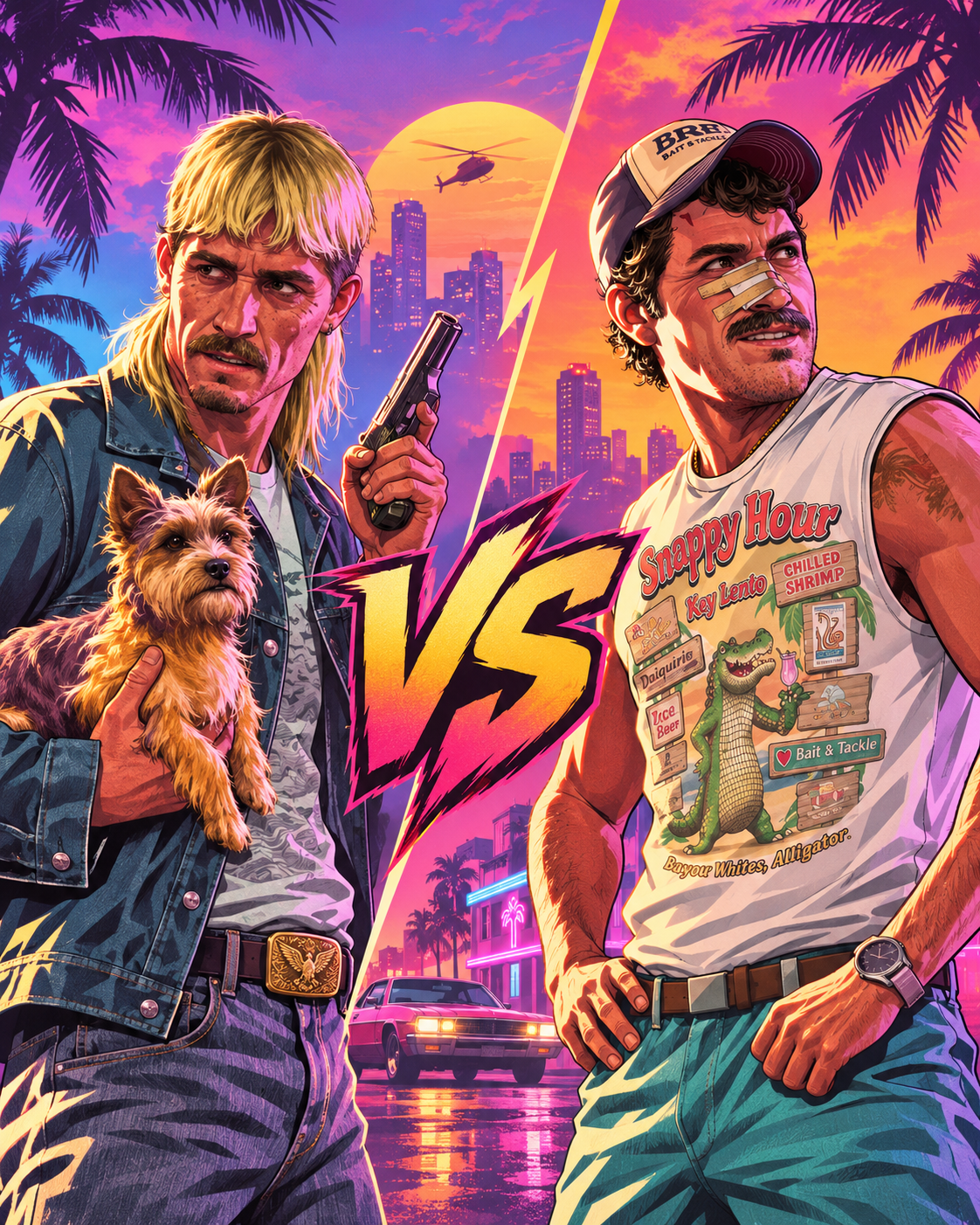
Consider Donnie and Dunk in Grand Theft Auto VI. Both are crude, reckless, unreliable men with an extraordinary talent for making bad situations worse. Yet early player discussions reveal an interesting distinction. Donnie is frequently treated as an insufferable liability, while Dunk, despite exhibiting many of the same characteristics, is often celebrated as an entertaining idiot.
One Reddit discussion captures this rather neatly. When someone suggested Dunk was even less intelligent than Donnie, another defended him because Dunk was funny. A different player argued that Dunk, unlike Donnie, wasn't constantly ruining their missions. It is hardly a scientific survey, and Donnie certainly has his defenders, but the distinction raises an interesting psychological question.
Are we judging these characters by their actions, or judging their actions according to how much we like them?
The Criminal We Conveniently Forget
Let's start with Donnie, because there is something rather revealing about the criticism directed at him.
In the early mission Gone Fishing, Jason helps Donnie skim cocaine from Brian's shipments. This is not an innocent man being reluctantly dragged into another criminal's disastrous scheme. Jason is actively involved, knowingly participating in the operation and expecting to benefit from it.
Naturally, things go wrong. Donnie ends up captured by the Kingfishers, Jason must rescue him, and the entire operation becomes considerably more complicated than originally advertised. Donnie's incompetence is easy to criticise, but there's a curious tendency to overlook Jason's participation. We are happy to accept the money, yet considerably less enthusiastic about accepting responsibility for how it was earned.
The pattern continues in Clean Up After Donnie, where another missing cocaine package sends Jason into a confrontation with the Kingfishers. Yet the mission also establishes Donnie as a buyer for stolen narcotics, giving Jason another opportunity to profit.
The game even makes this financially meaningful. For one early collection of cocaine, Donnie offers $3,400 compared with Brian's $2,720. That's a 25% premium for doing business with the supposedly intolerable idiot.
Donnie may be unreliable, but he is also useful. Jason is not simply suffering the consequences of somebody else's greed. He is pursuing his own financial interests through the very same criminal enterprise.
Now consider Dunk.
In Chapter 2's Slam Dunk, Lucia approaches Dunk looking for stronger painkillers for an injured Jason. His solution involves threatening a retired doctor at gunpoint, forcing him into a vehicle and initiating a chain of events that culminates in a violent confrontation with gang members.
Dunk's behaviour is hardly admirable. He is coercive, reckless and spectacularly incapable of anticipating consequences. Yet the sequence is entertaining, and crucially, he ultimately helps Lucia obtain what she needs. Later, he also becomes another useful contact for selling stolen goods.
So we have two unreliable criminals, both creating dangerous situations and both offering opportunities that benefit our protagonists. One becomes a frustrating obstacle; the other, an entertaining companion.
Perhaps the distinction says more about us than either of them.
The Halo Effect: He's Awful, But I Like Him
Psychology has a useful explanation for this apparent contradiction.
In a classic experiment, Nisbett and Wilson (1977) demonstrated how our overall impressions of people influence judgements about their individual characteristics. Participants watched a lecturer behaving either warmly or coldly. Those who encountered the likeable version subsequently rated his appearance, accent and mannerisms more favourably, despite watching the same individual.
This is the halo effect. A positive impression spills over into our evaluation of other qualities. The reverse, sometimes called the horn effect, occurs when an unfavourable impression makes us interpret someone's characteristics more negatively.
Applied to GTA VI, Dunk's humour may encourage players to interpret his recklessness as part of his charm. Donnie's irritating personality, meanwhile, makes similar behaviour seem further evidence of his incompetence. One is a lovable rogue; the other is simply a rogue.
Research by Bocian et al. (2018) takes this a step further. Across four experiments involving 645 participants, they found that factors influencing interpersonal liking could also influence perceptions of moral character. We don't necessarily like people because we have established that they are good. Sometimes, liking them makes us more inclined to see them as good.
There is another mechanism worth considering, particularly given Jason's involvement with Donnie.
Lu et al. (2026) investigated self-interest bias in moral character judgements, the tendency to evaluate people who behave immorally more favourably when their actions serve our own interests. Their findings also suggested that simply requiring people to justify their judgements did not reliably eliminate this bias.
This makes Jason's relationship with Donnie particularly revealing. When their arrangement generates money, we're inclined to view Jason as resourceful. When it generates trouble, Donnie becomes the fool responsible. The same criminal enterprise produces remarkably different interpretations depending on whose behaviour we happen to be evaluating.
Interestingly, self-interest bias might also lead us to expect greater forgiveness of Donnie, given that he offers Jason financial benefits. Yet his perceived incompetence and the trouble he causes may outweigh that advantage. We aren't necessarily judging him by a single standard, but weighing his usefulness against an impression we've already formed.
Of course, there are legitimate reasons to prefer Dunk. Humour, dialogue, performance and the experience of individual missions all influence how players respond to characters. Donnie's behaviour towards Lucia, for example, gives players reasons to dislike him beyond simple irritation at his incompetence. The two men aren't identical, and finding one more entertaining is hardly a moral failing.
The interesting question is whether that preference also changes how seriously we take their misconduct. The research offers plausible mechanisms, rather than proof that any particular GTA player is demonstrating them.
The People We Make Excuses For
There is something rather familiar about this distinction. A crude remark from a friend is dismissed as their sense of humour, while the same remark from an irritating colleague confirms everything we already suspected about them. Someone we admire is complicated or misunderstood; someone we dislike is simply objectionable.
We are remarkably inventive when finding excuses for people we like, and equally creative when identifying faults in people we don't.
Donnie and Dunk offer a particularly amusing illustration because GTA VI removes much of the moral ambiguity surrounding their occupations. Neither man is especially respectable, and both are willing participants in criminal enterprises that Jason and Lucia knowingly exploit. Yet we can still find ourselves applying different standards to their behaviour.
Perhaps Donnie really is more irritating than Dunk. Perhaps Dunk really is funnier. Neither possibility undermines the psychological point. Liking someone is perfectly reasonable; mistaking that affection for evidence of superior character is where things become interesting.
We like to believe we judge people by their actions. Sometimes, however, we judge their actions by how much we like them.
And if Donnie really is such an insufferable opportunist, perhaps Jason should stop taking his money.
References
Bocian, K., Baryla, W., Kulesza, W. M., Schnall, S., & Wojciszke, B. (2018). The mere liking effect: Attitudinal influences on attributions of moral character. Journal of Experimental Social Psychology, 79, 9–20. https://doi.org/10.1016/j.jesp.2018.06.007
Lu, Y., Miazek, K., & Bocian, K. (2026). Testing education and accountability as moderators of the self-interest bias in moral character judgments. Personality and Social Psychology Bulletin, 52(10), 3127–3143. https://doi.org/10.1177/01461672251364308
Nisbett, R. E., & Wilson, T. D. (1977). The halo effect: Evidence for unconscious alteration of judgments. Journal of Personality and Social Psychology, 35(4), 250–256. https://doi.org/10.1037/0022-3514.35.4.250
Rockstar Games. (2026). Grand Theft Auto VI [Video game]. Rockstar Games.
Table of Contents