The inhabitants of Twin Peaks seem driven by secrets, desires and contradictions. The world around them feels almost mythological. But what happens when our psychological theories begin shaping the reality we're trying to understand?
This article discusses the first season of Twin Peaks (1990), my reflections on Season One as a whole can be read here.
There is a moment early in Twin Peaks when a mounted deer head appears lying on a table. It has apparently fallen off the wall. Nothing supernatural, nothing particularly mysterious and certainly nothing requiring an elaborate psychological explanation.
Yet something about it feels profoundly strange.
It was one of the first moments that made me conscious of the peculiar relationship between people and their surroundings in David Lynch and Mark Frost's fictional town.
The inhabitants are eccentric enough. They lie, conceal affairs, behave irrationally, and seem to possess an almost inexhaustible supply of secrets. But their behaviour, however peculiar, generally remains within the boundaries of recognisable human experience.
The environment is another matter.
The woods, the imagery, the unusual visual details and the increasingly dreamlike atmosphere seem to suggest that the world itself possesses some significance beyond what we can immediately observe.
Partway through the first season, I found myself thinking about Carl Jung. Initially, I couldn't quite explain why. After all, there was plenty of material for a conventional Freudian interpretation, particularly given the extraordinary number of people apparently sleeping with someone they shouldn't.
Then the distinction occurred to me.
Freud was how I found myself reading the people. Jung was how I found myself reading the environment.
Not because I believed Twin Peaks had been constructed according to either psychologist's theories, but because I had noticed myself approaching the characters and their surroundings in fundamentally different ways.
And once I recognised that distinction, I began wondering whether I was uncovering something about the programme or, perhaps more interestingly, something about the way I was watching it.
Freud and the People We Pretend to Be
Freud's influence on our cultural understanding of human behaviour extends well beyond academic psychology.
We have inherited an extraordinary vocabulary of repression, unconscious desire, defence mechanisms and hidden motivations. So familiar are these ideas that we sometimes invoke them without considering whether they represent useful explanations, historical metaphors or merely attractive stories.
Freud's account of the unconscious proposed that mental life extends beyond what we can consciously access, and that psychological conflict can arise from impulses, wishes and processes operating outside awareness (Freud, 1915/1957).
The original psychoanalytic framework is not interchangeable with contemporary evidence-based psychology. Many of its specific theoretical claims remain disputed or difficult to test. Nevertheless, it offers a distinctive tradition of interpreting human behaviour through conflict, concealment and the relationship between what people acknowledge and what they may be motivated to avoid.
And Twin Peaks is positively overflowing with concealment.
Its inhabitants maintain public identities that frequently sit rather awkwardly alongside their private behaviour.
Relationships are complicated by jealousy, betrayal and conflicting loyalties. Respectable appearances coexist with decidedly less respectable activities. People seem invested in presenting versions of themselves that bear only a passing resemblance to what we gradually learn about them.
It would be easy to construct a Freudian interpretation of virtually every major character.
Leo Johnson's controlling behaviour invites questions about insecurity, power and the relationship between aggression and vulnerability. Bobby Briggs's bravado and emotional volatility raise questions about masculine identity, status and the need to maintain appearances.
Yet neither example establishes an unconscious conflict simply because one can be imagined.
There is a difference between identifying a psychological possibility and demonstrating that it explains someone's behaviour.
I became particularly interested in the apparent fragility of masculine authority throughout the first season. Several male characters seem preoccupied with controlling circumstances, asserting status or maintaining a particular image of themselves.
But it would be simplistic to place all of them under the heading of fragile masculinity and declare the matter settled.
Leo's intimidation, Bobby's volatility and Major Briggs's paternal authority represent quite different forms of behaviour. Their apparent similarities may be worth exploring, but they do not necessarily share a single psychological cause.
This is one of the dangers of an attractive theoretical framework. Once it offers us a compelling explanation, we can become rather reluctant to consider whether we're applying it too broadly.
And Twin Peaks provided an almost immediate demonstration of how easily that can happen.
Carl Rogers Enters the Room. Briefly.
When Major Garland Briggs first began speaking to his son Bobby, I was struck by the apparent contradiction between his appearance and manner.
Here was a man in military uniform, a visual shorthand for hierarchy, discipline and institutional authority, communicating with an almost therapeutic gentleness.
His delivery reminded me of Carl Rogers.
There was something unexpectedly reflective about the conversation, a manner that seemed closer to humanistic counselling than the stereotypical authoritarian military father.
I found the contrast rather endearing.
Then he struck Bobby.
So much for Rogers.
What made the moment interesting wasn't simply the sudden aggression. It was the speed with which my interpretation had been challenged.
I'd observed a particular communication style, associated it with a psychological tradition, and begun constructing an impression of the person displaying it.
Then new evidence arrived.
It didn't necessarily invalidate everything about the earlier interaction, but it made the broader conclusion considerably more difficult to sustain.
I had been interpreting behaviour through the associations it evoked rather than through sufficient evidence about the person performing it.
This is hardly an unusual cognitive tendency.
Nickerson's (1998) review of confirmation bias describes the many ways people may seek, interpret and evaluate information in ways that favour existing expectations or hypotheses.
Once an explanation becomes appealing, we may become particularly attentive to evidence that supports it, while minimising details that complicate the picture.
In Briggs's case, the contradiction arrived quickly enough that I had little opportunity to become attached to my interpretation.
Had the scene unfolded differently, I might have spent considerably longer congratulating myself for recognising his apparently Rogerian qualities.
Which would have been a rather less impressive display of psychological expertise than it sounds.
Jung and the World Beyond the Window
While the characters invited questions about personal motivations and internal conflict, the town itself seemed to invite something different.
I began noticing visual details that appeared almost ritualistic. Some commercial signage suggested religious or esoteric symbolism. Imagery associated with Indigenous traditions seemed to occupy parts of the programme's visual periphery. The woods, meanwhile, possessed a peculiar presence that seemed to extend beyond their role as a physical setting.
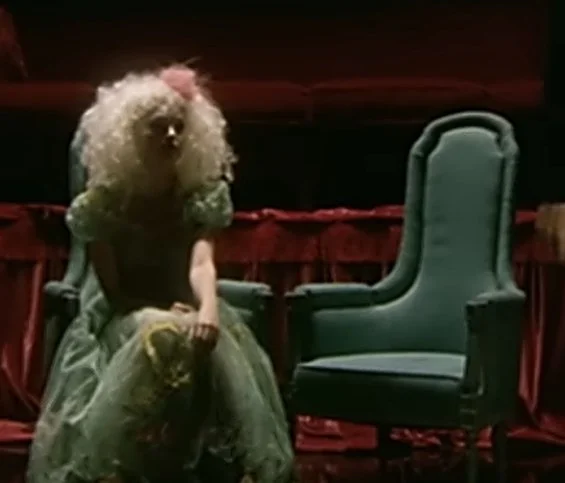
Then came Cooper's dream in the red room.
By this point, my Jungian associations were becoming difficult to ignore.
Jung's analytical psychology placed considerable emphasis on symbols, dreams, myths and archetypal patterns. His conception of the collective unconscious proposed that certain psychological structures and recurring symbolic forms extended beyond an individual's personal experience (Jung, 1964).
These ideas have had enormous influence on literature, art and cultural interpretation, even where their stronger psychological claims lack convincing empirical support.
And I could understand their attraction while watching Twin Peaks.
The woods didn't merely feel like somewhere events might happen. They seemed to possess a kind of psychological presence.
The dream sequences appeared to operate according to rules that weren't entirely compatible with ordinary waking experience. Objects and locations seemed capable of accumulating significance beyond their physical properties.
The world felt less like a neutral backdrop and more like something participating in the story.
In an ordinary crime drama, a forest might be somewhere evidence is discovered or a suspect attempts to escape. In Twin Peaks, I found myself wondering what the forest represented before I knew whether it represented anything at all.
And that distinction matters.
A setting can feel symbolic without possessing a single decipherable meaning.
Nor should every unfamiliar cultural image be absorbed into a vague idea of Jungian mysticism. Indigenous cultural traditions have their own histories and meanings; they are not simply interchangeable symbols waiting to be recruited into a European psychological framework.
Nevertheless, I noticed that the programme was encouraging me to approach its environment differently from its inhabitants.
With the characters, I was asking what might explain their behaviour.
With the environment, I was asking what things might mean.
Those are not identical questions.
When a Fish Is Just a Fish
The trouble with symbolic interpretation is that it can become extraordinarily accommodating.
Once we start searching for hidden significance, almost anything can appear meaningful.
Consider the fish in the percolator.
Cooper's appreciation of coffee has already become one of his most recognisable characteristics. The morning ritual seems to embody something important about his enthusiasm for ordinary experiences.
Then, quite inexplicably, there's a fish in the coffee equipment.
One could spend considerable time interpreting this intrusion.
Perhaps the fish represents the contamination of everyday life by something unexpected. Perhaps the disruption of the coffee ritual symbolises the intrusion of the irrational into an ordered world. Perhaps it gestures towards the relationship between the natural environment and domestic civilisation.
Or perhaps somebody put a fish in the percolator.
That's the difficulty.
Symbolic explanations can be fascinating, but without some way of distinguishing better interpretations from worse ones, their flexibility becomes a weakness.
The same problem applies to the deer head.
At the beginning of my viewing experience, it struck me as the first genuinely absurd image in the programme.
But its immediate explanation was wonderfully mundane. It had fallen down.
What interested me wasn't necessarily the hidden meaning of the deer head. It was that an ordinary object, placed in an unexpected context, could produce such a strong sense of incongruity.
We don't need to invoke a universal archetype to explain why something familiar can become strange.
Contemporary theories of perception increasingly emphasise the interaction between incoming information and our expectations about the world. Clark's (2013) influential account of predictive processing describes perception as involving ongoing attempts to interpret sensory input through internally generated models and predictions.
This is a theoretical framework rather than a settled explanation of every perceptual experience, and it should not be stretched into a universal theory of artistic interpretation.
Nevertheless, it reminds us of something important: perception is not simply the passive recording of external reality.
What we expect to encounter can influence how we interpret what actually appears.
A deer head mounted on a wall might barely register. The same deer head lying inexplicably on a table becomes conspicuous.
The object hasn't acquired supernatural properties.
Our expectations have been violated.
And perhaps that is enough to make the ordinary feel extraordinary.
People Are Objectively There. Experience Is Another Matter.
Another thought emerged as I watched the relationship between the inhabitants of Twin Peaks and the environment they occupied.
The people are objectively there, but their experience of reality is subjective.
Which means that lived experience is, in an important sense, objectively subjective.
That sounds slightly contradictory, but I don't think it is.
We can acknowledge an external world without assuming that everyone encounters or understands that world in the same way.
The same location may evoke comfort in one person, anxiety in another and indifference in a third. An apparently unremarkable object can carry powerful personal associations. A familiar environment can feel profoundly different depending on memory, expectation and emotional state.
The existence of subjective experience is not itself in dispute. What differs is its content, interpretation and relationship to the external world.
This became an increasingly useful way of thinking about Twin Peaks.
Its inhabitants appear to share a physical community, yet their relationships with that community are shaped by very different personal histories, desires and assumptions.
And the programme occasionally seems willing to present subjective significance as though it were part of the world's physical structure.
Cooper is particularly interesting in this respect.
His enthusiasm for mundane things suggests someone unusually receptive to the possibilities of ordinary experience. A tree isn't merely a tree to him. It's an occasion for wonder.
His investigative methods demonstrate a similar openness.
He can conduct a recognisably professional investigation while remaining willing to entertain information arising from dreams, intuition or seemingly improbable associations.
After his red-room dream, he announces a remarkable degree of confidence about the identity of Laura Palmer's killer.
The psychologist in me immediately wants to know how that confidence will be justified.
A subjective experience can be entirely genuine without the interpretation drawn from it being objectively correct.
A dream may feel meaningful. That doesn't establish that it provides reliable information about a murder.
But there is an important difference between treating a dream as evidence and allowing it to suggest a hypothesis that might subsequently be investigated.
Cooper seems unusually comfortable with that distinction, even if his confidence sometimes runs ahead of what the available evidence would justify.
What fascinated me was not whether his methods represented good investigative practice.
It was his apparent willingness to move between different ways of approaching the unknown without treating them as mutually exclusive.
He could take an ordinary physical object seriously, entertain an extraordinary possibility and still return to the practical business of investigating a crime.
In that respect, he seemed to occupy an interesting position between the psychological world of the characters and the symbolic environment surrounding them.
Not because he somehow reconciled Freud and Jung, but because he challenged my impulse to separate those two modes of interpretation in the first place.
The Problem With Finding What You're Looking For
There is, of course, a rather obvious objection to my entire interpretation.
Why should Freud belong to the people and Jung to the woods?
Freud devoted substantial attention to dreams, symbolism and the uncanny. Jung was deeply concerned with individual personality, psychological development and internal conflict.
Neither can be neatly assigned to one half of a fictional town.
My distinction was never intended as a faithful division of their respective theoretical contributions.
It described my own experience.
When watching the characters, I instinctively looked towards personal motivations, concealed desires and interpersonal contradictions.
When watching the environment, I became more interested in symbols, atmosphere and the possibility of meaning extending beyond immediate appearances.
The more intriguing question is why I found myself making that distinction.
Was something about the programme encouraging it?
Or had my own psychological knowledge supplied two familiar interpretive frameworks that I subsequently imposed upon what I was watching?
Probably some combination of the two, although I have no reliable way of establishing the precise balance.
This is where the distinction between psychological interpretation and psychological evidence becomes essential.
Nickerson (1998) describes confirmation bias not as a single simple mistake, but as a family of tendencies affecting how people search for and interpret information.
Once I had begun thinking about Jung, I found myself increasingly attentive to imagery that seemed Jungian.
The woods became more conspicuous. Dreams became more significant. Unusual symbols seemed to invite examination.
But how many ordinary objects, unremarkable settings and unrelated details was I ignoring?
I couldn't say.
And that uncertainty matters because a sufficiently flexible psychological framework can become almost impossible to challenge.
If an image fits our interpretation, we treat it as supporting evidence. If it doesn't fit, perhaps its apparent inconsistency merely reveals a deeper symbolic contradiction.
Either way, the theory survives.
That's an excellent arrangement for protecting a theory from criticism.
It's a considerably less satisfactory arrangement for determining whether the theory explains anything.
We also need to distinguish interpretation from empirical claims.
A Jungian reading of the woods might be artistically rewarding without establishing Jung's account of the collective unconscious.
A Freudian reading of a character's behaviour might illuminate a fictional conflict without demonstrating that repression caused it.
And an interpretation doesn't become scientifically credible simply because the person making it happens to be a psychologist.
Psychological theories can provide useful vocabularies for discussing literature and television.
But a vocabulary is not a verdict.
Simply puy
By the end of the first season, I hadn't abandoned my initial distinction.
I still found myself reading the characters through a broadly Freudian lens and the environment through a broadly Jungian one.
The contrast remained useful.
But I'd become less interested in whether it represented the correct way to understand Twin Peaks and more interested in what it revealed about the activity of interpretation.
We rarely encounter the world, or indeed a television programme, without expectations.
We bring memories, knowledge, beliefs, preferences and familiar explanatory frameworks to everything we experience.
Those frameworks help us recognise patterns and make sense of complicated information. Without them, the world would be considerably harder to navigate.
But they can also make us overconfident.
A character behaves strangely, and we reach for a psychological explanation. An unfamiliar symbol appears, and we assume it must signify something. A pattern emerges, and we begin to suspect that every subsequent detail belongs to it.
Sometimes these interpretations are illuminating.
Sometimes they're merely elaborate.
And sometimes there's a fish in the percolator because somebody put a fish in the percolator.
What Twin Peaks gave me was not a definitive demonstration of Freudian or Jungian psychology, nor a reason to treat its mysteries as a coded psychological puzzle.
It gave me an opportunity to notice the theories I was bringing into the room.
Freud helped me think about the contradictions within the people. Jung helped me think about the symbolic possibilities of their surroundings. Contemporary cognitive psychology made me question how confidently I was drawing either conclusion.
None of these approaches provided a complete explanation.
Perhaps that is precisely why the experience remained interesting.
There is something satisfying about recognising a pattern, especially when we possess the vocabulary to describe it. But understanding requires more than finding an explanation that sounds plausible.
It also requires recognising where that explanation stops.
I began watching Twin Peaks wondering what might be lurking beneath the surface of its people and their peculiar little town.
By the end of the first season, I was also wondering how much of what I thought I could see had been brought there by me.
Freud was still in the people. Jung was still in the woods.
But perhaps I ought to have been keeping a closer eye on the psychologist sitting in front of the television.
References
Clark, A. (2013). Whatever next? Predictive brains, situated agents, and the future of cognitive science. Behavioral and Brain Sciences, 36(3), 181–204. https://doi.org/10.1017/S0140525X12000477
Freud, S. (1957). The unconscious. In J. Strachey (Ed. & Trans.), The standard edition of the complete psychological works of Sigmund Freud (Vol. 14, pp. 159–215). Hogarth Press. (Original work published 1915)
Jung, C. G. (1964). Approaching the unconscious. In C. G. Jung (Ed.), Man and his symbols. Doubleday.
Nickerson, R. S. (1998). Confirmation bias: A ubiquitous phenomenon in many guises. Review of General Psychology, 2(2), 175–220. https://doi.org/10.1037/1089-2680.2.2.175
Table of Contents