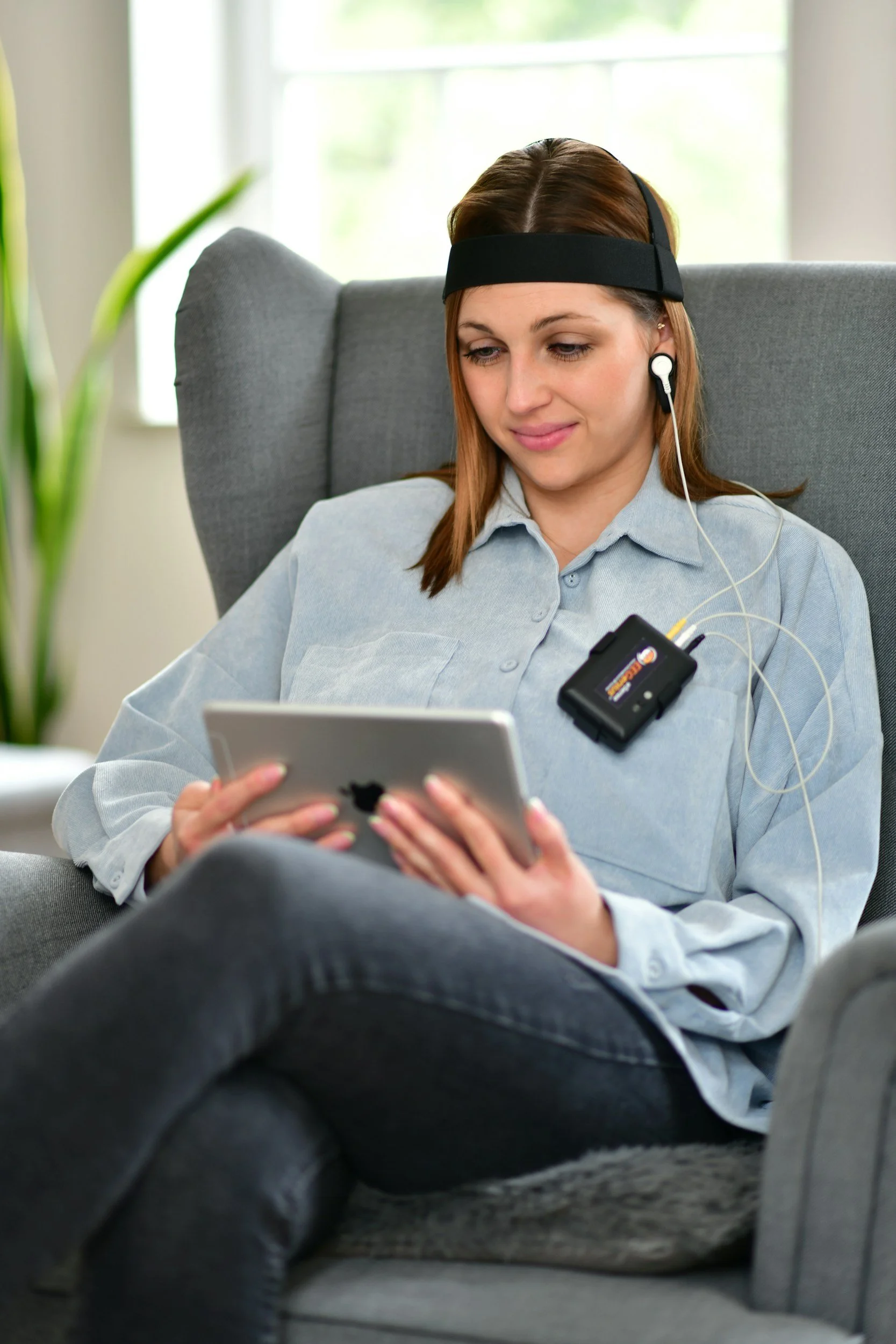
EEG offers a fascinating window into the meditating brain. But can it tell us whether someone is actually being mindful?
Psychology has developed an impressive collection of questionnaires designed to measure mindfulness. We can ask people how attentive they are, how often they operate on autopilot, and whether they notice their thoughts without immediately getting caught up in them. We can then turn those answers into numbers, compare groups, and investigate whether meditation changes anything.
There is, however, a rather obvious complication. We are asking people to tell us how aware they are of their own awareness. That is not necessarily a straightforward task, particularly when the thing we are trying to measure includes noticing what usually escapes our attention.
So perhaps we should stop asking people and look at their brains instead.
Electroencephalography, or EEG, seems an attractive candidate. It records electrical activity from the scalp, allowing researchers to examine changes in brain activity as people meditate. Unlike a questionnaire, it does not depend on someone deciding whether they are the sort of person who is generally mindful.
The appeal is understandable. Unfortunately, an objective measurement is not automatically an objective measurement of the thing we are interested in.
What happens to the brain during meditation?
EEG measures patterns of electrical activity produced by populations of neurons. Researchers often examine these patterns in terms of frequency bands, commonly labelled delta, theta, alpha, beta and gamma. Different frequencies are associated with different aspects of brain function, although none has a single, exclusive psychological meaning.
Alpha activity, for example, is often associated with relaxed wakefulness and changes in attention. Theta activity has been linked with memory, cognitive control and drowsiness, depending on where and when it occurs. Gamma activity has attracted interest because of its possible involvement in the coordination of neural processing.
This gives researchers something tangible to investigate. If meditation involves changes in attention, awareness or emotional regulation, perhaps those changes will be reflected in EEG activity.
And, to some extent, they are.
A systematic review published by Lomas and colleagues in 2015 examined 56 studies involving 1,715 participants. It found that mindfulness meditation was commonly associated with increases in alpha and theta activity, although the findings were far from uniform. The authors suggested that these patterns might reflect a state of relaxed alertness.
That sounds rather promising. Relaxed alertness is, after all, a reasonable description of what many meditation practices are trying to cultivate.
There is just one difficulty. Alpha and theta activity are not exclusive to meditation. They also change when we close our eyes, relax, become tired or begin drifting towards sleep. A person sitting quietly with their eyes shut may therefore produce some of the same EEG changes as someone practising mindfulness.
This does not mean meditation is simply a more respectable way of having a nap. It means we need better comparisons before deciding what the brainwaves signify.
The problem with finding a meditation signature
The idea of a distinctive neural signature of meditation is appealing. Find the right combination of brainwaves, and perhaps we could identify mindfulness as it happens.
But meditation is not one activity.
Someone concentrating on their breathing is doing something rather different from someone openly observing whatever enters awareness. A person practising compassion meditation is engaging with a different set of mental processes again. Putting all these practices into a single category may be convenient for research, but convenience is not the same as conceptual precision.
Even within the same practice, experiences vary. One person might be sustaining attention remarkably well. Another might be distracted for most of the session, occasionally remembering what they were supposed to be doing. From the outside, both are sitting quietly. Their EEG recordings may differ, but interpreting those differences is another matter.
The findings are also less consistent than some popular accounts suggest.
For example, a 2024 study involving 52 healthy young adults found that alpha activity actually decreased during mindfulness meditation compared with eyes-closed rest. A separate study involving 40 novice meditators also reported lower alpha activity during meditation than during rest, while examining changes following six weeks of practice or an active comparison activity.
These findings do not necessarily contradict earlier research. Differences in meditation instructions, participants, recording methods and comparison conditions can all influence the results. They do, however, make it difficult to maintain that mindfulness simply increases a particular brainwave.
A systematic review and exploratory meta-analysis published in September 2026 adds another complication. Across the studies it analysed, the researchers found positive pooled effects for alpha, beta and gamma activity, but not a statistically significant overall effect for theta. They also reported substantial variation between studies and cautioned against strong interpretations of some apparent differences between meditation and resting states.
In other words, there is evidence that meditation is associated with changes in brain activity. There is considerably less agreement about which changes are characteristic of meditation, let alone mindfulness itself.
What about the monks with remarkable brainwaves?
One of the most widely discussed EEG studies of meditation was published by Antoine Lutz and colleagues in 2004.
The researchers examined eight highly experienced Buddhist practitioners, some with tens of thousands of hours of meditation practice, alongside ten comparison participants. During a compassion meditation exercise, the experienced practitioners showed unusually strong gamma-band activity and synchronisation.
The findings were intriguing. They suggested that extensive mental training might be associated with patterns of neural activity not typically observed in people without comparable experience.
It is easy to see why this study attracted attention. The prospect of experienced meditators producing extraordinary brainwaves makes for a compelling story, particularly if we are already inclined to believe that meditation can transform the mind.
But the study was small, and its participants differed in more ways than meditation experience alone. The comparison group was also substantially younger. The researchers undertook analyses to address potential muscle contamination, yet distinguishing high-frequency brain activity from electrical signals produced by facial and scalp muscles remains a broader challenge for EEG research.
None of this makes the findings uninteresting. It simply means we should resist treating them as proof that meditation produces a superior state of consciousness.
There is also a more fundamental question. Even if experienced meditators reliably produce distinctive gamma activity, what does that tell us about their psychological functioning?
Does it mean they are more attentive? More compassionate? Less reactive to distress? Better able to notice their thoughts without becoming entangled in them?
Those are separate questions, and a remarkable EEG recording does not answer them automatically.
Is EEG better than asking people?
It is tempting to frame the issue as a contest between subjective questionnaires and objective brain measurements. Self-report has obvious limitations. People may misunderstand questions, answer according to how they would like to see themselves, or lack insight into their own mental habits.
Meditation introduces another complication. As people become more attentive to their internal experiences, they may also become more aware of how frequently their minds wander. Someone could therefore become more skilled at noticing distraction while reporting that they are distracted more often.
A questionnaire score might suggest that little has improved, even when the person's relationship with their thoughts has changed.
EEG avoids some of these problems, but it introduces others.
A recording can tell us that electrical activity has changed. It cannot, by itself, tell us whether someone is observing their thoughts non-judgementally, feeling compassionate towards another person, or quietly planning what to have for dinner.
This is a problem of construct validity. We need to establish that a measurement genuinely reflects the psychological characteristic we claim it measures.
A thermometer provides an objective measurement of temperature because the relationship between the instrument and the thing being measured is well established. EEG does not yet offer an equivalent measure of mindfulness.
Brain activity is real, measurable and potentially informative. The difficulty lies in moving from a pattern of electrical activity to a claim about a complex psychological experience.
That is a much bigger leap than it first appears.
Perhaps we are asking the wrong question
Instead of asking whether EEG can measure mindfulness, it may be more useful to ask what EEG can contribute to our understanding of meditation.
For example, researchers could investigate whether changes in brain activity during meditation predict improvements in sustained attention. They could examine whether particular EEG patterns are associated with reduced emotional reactivity, or whether these patterns change as people develop experience with a specific practice.
These questions allow EEG to do what it does well: provide information about the timing and dynamics of neural activity.
The strongest research designs would combine several kinds of evidence. Participants might complete validated mindfulness questionnaires, undertake behavioural attention tasks, and have their EEG recorded during carefully defined meditation and comparison conditions. Ideally, studies would also measure changes over time and include an active control group, rather than simply comparing meditators with people who have never meditated.
That last distinction matters. Experienced meditators may differ from non-meditators in personality, lifestyle, motivation and numerous other ways. Finding a difference between the two groups does not establish that meditation caused it.
Researchers would also need to consider whether the eyes are open or closed, whether participants are becoming drowsy, how movement and muscle artefacts are handled, and whether the same findings appear in independent samples.
It is less glamorous than discovering the brainwave of enlightenment. It is also considerably more likely to produce useful science.
Perhaps most importantly, subjective experience should not be discarded simply because we have access to electrodes.
Mindfulness is partly concerned with how people experience and relate to their thoughts, feelings and surroundings. If we want to understand that experience, asking people about it remains relevant. The challenge is to develop better ways of combining their reports with behavioural and physiological evidence.
Simply Put
EEG research provides good reason to think that meditation is associated with measurable changes in brain activity. Some findings are consistent with changes in attention and arousal, and studies of experienced practitioners raise interesting questions about the effects of prolonged training.
What the evidence does not currently provide is a reliable, universally applicable brainwave signature of mindfulness.
That distinction is worth preserving. We can accept that meditation affects the brain without assuming that every observed change represents greater awareness, improved wellbeing or psychological progress.
The most interesting possibility may not be that EEG will eventually replace mindfulness questionnaires. It may be that brain recordings, behavioural measures and carefully collected personal reports can reveal different aspects of the same process.
After all, if we are studying awareness, it would be rather strange to decide that the one person whose experience no longer matters is the person actually having it.
References
Cahn, B. R., & Polich, J. (2006). Meditation states and traits: EEG, ERP, and neuroimaging studies. Psychological Bulletin, 132(2), 180–211. https://doi.org/10.1037/0033-2909.132.2.180
Duda, A. T., Clarke, A. R., & Barry, R. J. (2024). Mindfulness meditation alters neural oscillations independently of arousal. International Journal of Psychophysiology, 205, Article 112439. https://doi.org/10.1016/j.ijpsycho.2024.112439
Lomas, T., Ivtzan, I., & Fu, C. H. Y. (2015). A systematic review of the neurophysiology of mindfulness on EEG oscillations. Neuroscience & Biobehavioral Reviews, 57, 401–410. https://doi.org/10.1016/j.neubiorev.2015.09.018
Lutz, A., Greischar, L. L., Rawlings, N. B., Ricard, M., & Davidson, R. J. (2004). Long-term meditators self-induce high-amplitude gamma synchrony during mental practice. Proceedings of the National Academy of Sciences, 101(46), 16369–16373. https://doi.org/10.1073/pnas.0407401101
Yan, T., Wei, Y., Geng, F., Chen, S., Zhou, H., & Hu, Y. (2026). EEG oscillatory correlates of meditation practice: A systematic review and exploratory meta-analysis. Neuroscience, 611, 324–338. https://doi.org/10.1016/j.neuroscience.2026.07.012
Table of Contents