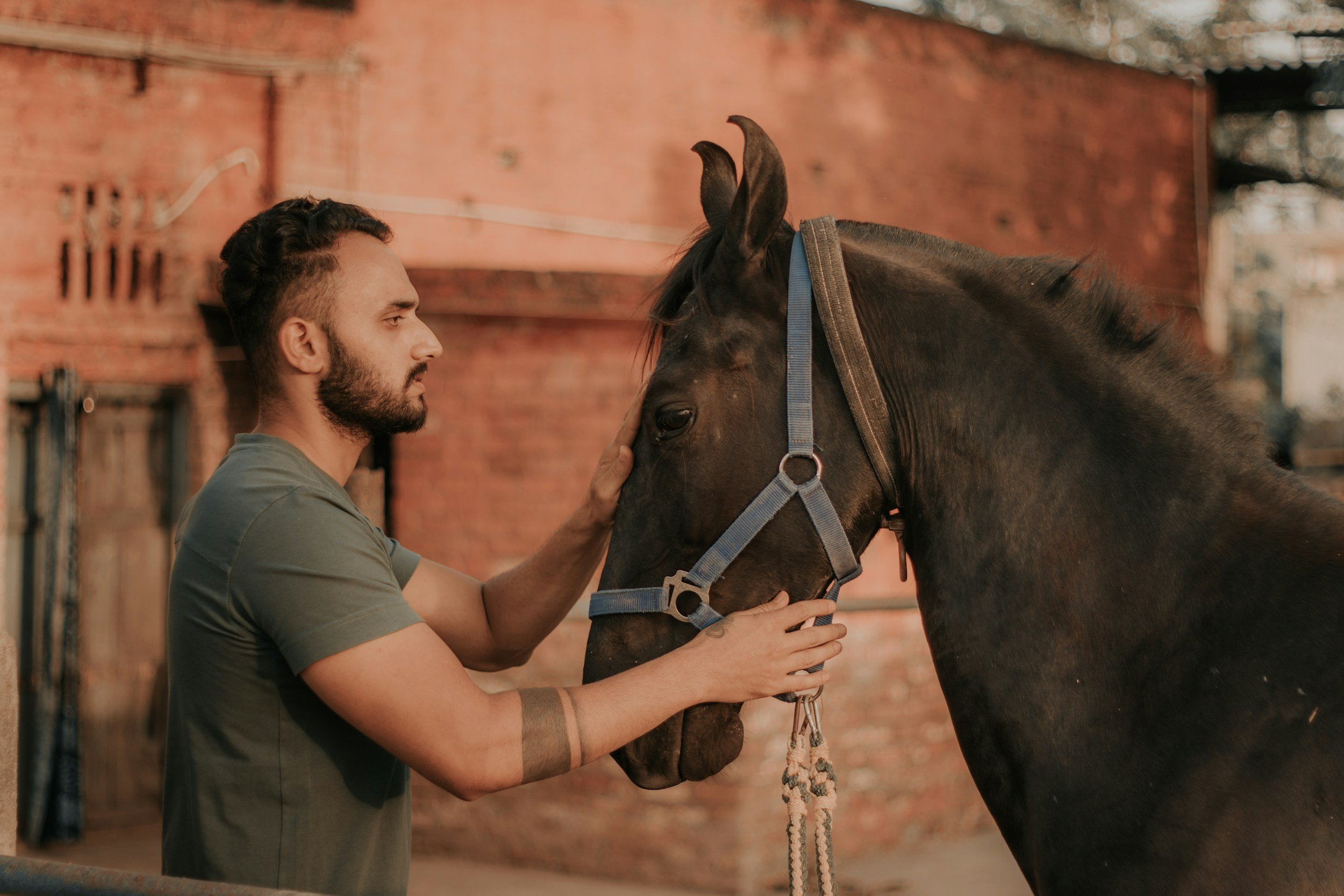
A structured session with a horse can give someone in addiction treatment a hands-on way to practise noticing tension, asking for help, or working through a task at a manageable pace.
Some participants say they value the change of setting and the chance to do something alongside a horse. Research has yet to establish whether adding these sessions improves substance use outcomes or makes people more likely to complete treatment.
That distinction matters when you read about a programme. A person can find a session meaningful, and researchers can still have an open question about what difference it makes over time.
Simply Put Psych’s recent review of the evidence for clinical hypnotherapy raises a similar question about how to judge an approach offered alongside usual care.
In the case of horses, it helps to start by looking at what actually happens during a session.
What happens in a structured session with a horse?
A participant might be invited to stand at a comfortable distance, watch the horse, or try grooming or leading it with guidance. Activities vary with the programme and the person’s preferences, comfort and physical access. Some programmes work from the ground. The published studies reviewed by Diaz and colleagues (2022) included different activities and goals, which is one reason the phrase “equine-assisted services” covers a range of experiences.
Imagine a participant who starts a grooming task and becomes tense when the horse shifts its weight.
A facilitator might help them step back safely, notice what happened, and decide whether they want to continue. In a session with a clinical goal, the clinician may invite the participant to think about how they recognised their own tension or what made it easier to ask for help. The task gives them a specific moment to discuss.
Ask what kind of service it is
An activity may be organised as recreation, as an opportunity to learn a skill, or as part of work with a qualified clinician.
Ask what the programme means by “equine therapy.” Who is responsible for the clinical part, if there is one? Who is responsible for handling the horse? How will the team decide which activities fit the goals and preferences you discuss?
You can also ask how staff handle an animal that needs space or how they respond when a participant wants to stop.
Horses can move unpredictably, and some people will prefer to observe from farther away. Look for a clear account of how both humans and animals are supervised and how people can opt out or choose an alternative.
What participants have reported
A 2022 scoping review found accounts of participants enjoying the hands-on work, valuing a change from the usual treatment setting, and developing a bond with a horse (Diaz et al., 2022).
Some participants described looking forward to the sessions. The review also included reports from people who were afraid of horses or disliked parts of the setting. Many of the qualitative examples came from younger populations, so it is worth taking care when applying their accounts to another group.
Interviews and observations help researchers understand why an experience matters to participants. They can show that someone appreciated a chance to be outdoors, or that working with a horse made it easier for them to talk about asking for help.
They can also reveal barriers a programme designer or service directory for registered equine services might overlook, such as discomfort with the animals or the environment. Those are useful findings for planning a service and deciding what to study next.
Enjoyment and longer-term change are different outcomes
A conversation about whether people enjoyed a session can be answered with interviews or questionnaires. Finding out whether it helped people complete a course of care requires different evidence. Understanding what happened to substance use after people left treatment would take follow-up and appropriate measures of its own.
Programme descriptions often combine these questions into a general promise about recovery. If you come across a broad claim, look for the point at which the outcome was measured and whose experience it represents. A report on how people felt immediately after a session answers a narrower question than a report on what happened six months later.
What the comparison studies can tell us
A prospective study in Norway found that young adults who participated in horse-assisted therapy stayed in substance use treatment longer and were more likely to complete it than those who received usual treatment alone (Kern-Godal et al., 2015). The group comparison was observational.
People who participated could have differed from others in ways that also affected how long they stayed. For instance, willingness to take part in an optional programme could be related to interest in the wider treatment programme.
A later randomised study assigned participants to usual care with or without complementary horse-assisted therapy. Among the 37 participants in the analysis described by the authors, the study found no statistically significant association between the intervention and treatment outcome, which included completion, dropout and transfers (Gatti et al., 2020).
Attendance at the horse-assisted sessions varied, and transfers and interruptions made the comparison harder to interpret. The result leaves uncertainty about the size and direction of any benefit.
What a stronger study would need to show
Researchers would need to describe the sessions clearly enough for another team to repeat them, record who attends and how often, and choose the outcomes before looking at the results. A study interested in long-term recovery would need to follow people after the programme ended.
A comparison with another structured activity could also help researchers understand what might come from working with horses and what might come from time outdoors, focused attention from staff, or a purposeful change in routine.
For now, the scoping review found too little rigorous evidence to draw a firm conclusion about effectiveness in substance use treatment (Diaz et al., 2022). There is room to study what people report finding helpful. If improved completion or longer-term substance use outcomes matter to your decision, those claims require evidence that measures them directly.
How to ask a programme about its horse-assisted sessions
Begin with the care you would receive throughout the week. Ask where the horse-assisted sessions fit, what clinical care is available, and how the team sets goals for each element of the programme. A provider’s description can help you prepare.
Ingrained Recovery offers an example, as an adult detox and treatment provider in Georgia, they describe equine-assisted programming as a central part of residential addiction care. Its programme page is an example of the kind of description to read before asking how a session would fit your needs.
Ask for a walk-through of an ordinary session.
What might you do on the first visit?
Can you begin by observing?
If you feel uncomfortable, can you leave the activity or choose another?
Those questions may also matter if the setting presents physical barriers, you have allergies, or your experience around large animals is limited.
Ask how the team decides whether to continue
If the goal is to practise asking for help, find out how the facilitator and clinician revisit that goal. You might learn something through a hands-on task that comes up again in counselling. Another person may work on the same skill in a group or individual session. Ask how staff will respond if an activity is enjoyable but you see little connection to the goal you discussed.
When comparing written descriptions, look for ordinary details. Group size, time spent discussing the activity, and who leads the session tell you more about the work than a photograph of a paddock. Ask whether a person can still take part in the rest of treatment if they choose a different activity. That helps you weigh the option before committing to it.
The same questions apply when comparing two services that both use horses. One may offer a regular group activity, while another includes individual work for a specific clinical goal. Ask how each provider would explain that difference to someone attending for the first time.
The immediate value of a session might be clear to the person who took part. You can see how someone would remember the first time they asked to pause and a facilitator respected the request. Whether that experience leads to a lasting change is a separate question.
A provider should be able to talk you through the purpose of each session and the place it occupies in the care you receive before and after it.
References
Diaz, L., Gormley, M. A., Coleman, A., Sepanski, A., Corley, H., Perez, A., & Litwin, A. H. (2022). Equine-assisted services for individuals with substance use disorders: A scoping review. Substance Abuse Treatment, Prevention, and Policy, 17, Article 81. https://doi.org/10.1186/s13011-022-00506-x
Gatti, F., Walderhaug, E., Kern-Godal, A., Lysell, J., & Arnevik, E. A. (2020). Complementary horse-assisted therapy for substance use disorders: A randomized controlled trial. Addiction Science & Clinical Practice, 15, Article 7. https://doi.org/10.1186/s13722-020-0183-z
Kern-Godal, A., Arnevik, E. A., Walderhaug, E., & Ravndal, E. (2015). Substance use disorder treatment retention and completion: A prospective study of horse-assisted therapy (HAT) for young adults. Addiction Science & Clinical Practice, 10, Article 21. https://doi.org/10.1186/s13722-015-0043-4
Table of Contents