What Are Eros and Thanatos in Freud?
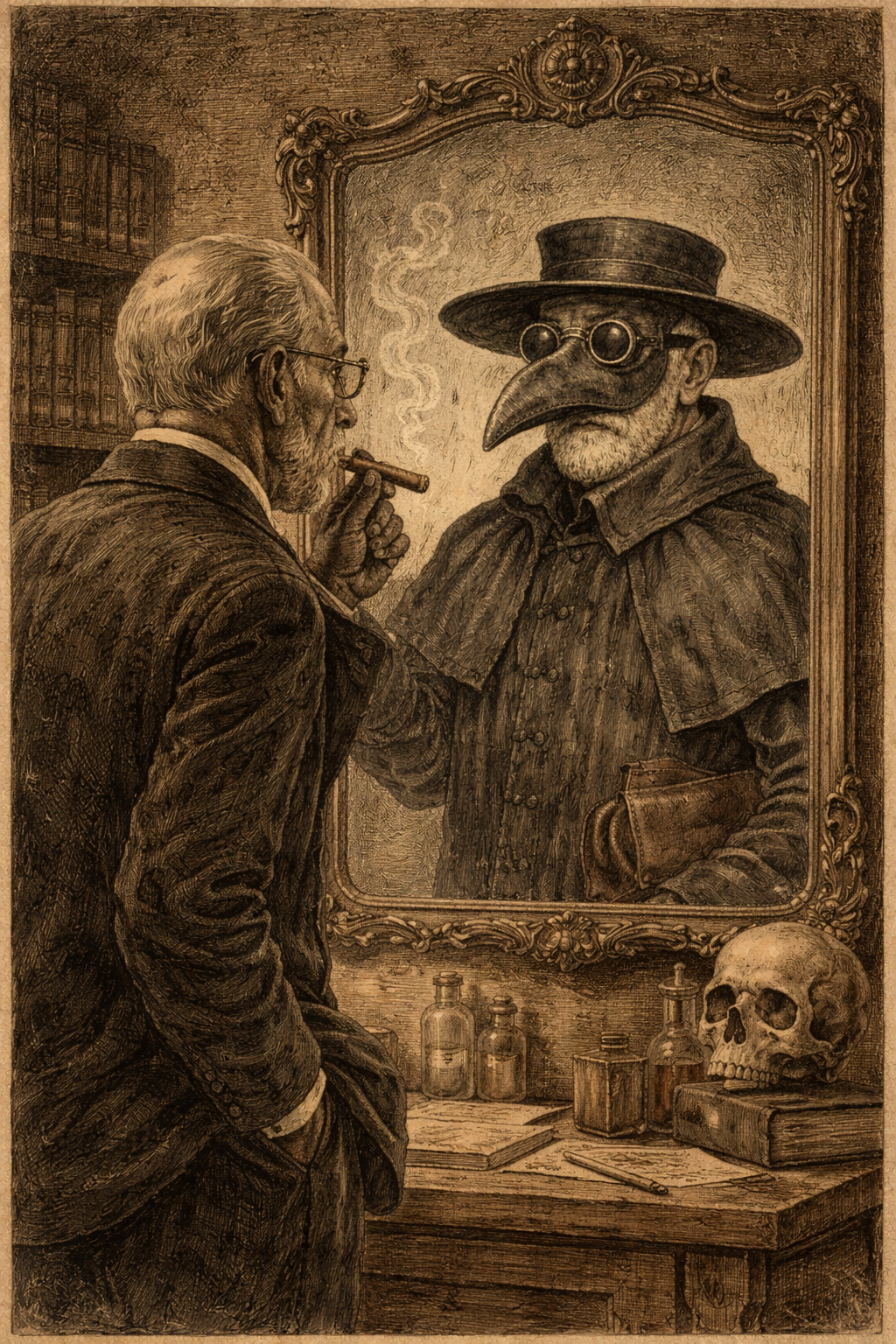
Freud’s later theory of the mind did not stop at pleasure, desire, and repression. He eventually argued that human beings are pulled by two opposing forces: Eros, which binds, preserves, and creates life, and the death drive, often popularly paired with Eros under the name Thanatos, which pushes toward destruction, repetition, and a return to an earlier, less tense state. Whether you see it as brilliant, bleak, or wildly speculative, it remains one of Freud’s most provocative ideas.
Why Freud needed more than the pleasure principle
Freud’s early model of mental life leaned heavily on the pleasure principle, the idea that the mind tries to reduce tension and seek pleasure. But over time he became increasingly troubled by phenomena that did not fit neatly into that picture. In Beyond the Pleasure Principle (1920), he pointed to traumatic dreams that repeatedly returned patients to the scene of trauma, especially in traumatic neuroses, and to what he called a compulsion to repeat, something that seemed “more primitive, more elementary, more instinctual” than the pleasure principle it appeared to override.
This mattered because it suggested that the human mind does not always move toward comfort, relief, or gratification in any straightforward sense. Sometimes people seem drawn back toward what hurts them. Freud saw this not just in dreams, but in symptoms, relationships, analysis, and patterns of life that felt self-defeating. That did not mean he abandoned conflict as a core feature of the psyche. It meant he radicalised it. The mind, he began to argue, may contain a force that does not simply seek pleasure, but pushes toward undoing, repetition, and even destruction.
Eros: the drive toward life, union, and binding
When people hear Eros, they often think only of romance or sex. Freud meant something broader. In Beyond the Pleasure Principle, he explains that what had once been called the sexual instincts had been enlarged into Eros, a force that “seeks to force together and hold together the portions of living substance.” In his later lectures, he described the erotic instincts as those that seek “to combine more and more living substance into ever greater unities.”
So Eros is not merely about sexual desire in the narrow sense. It is Freud’s name for the tendency toward connection, preservation, attachment, synthesis, and creation. It includes sexuality, but it is not limited to it. In Freud’s later drive theory, Eros becomes the great life-binding force: the pressure toward union rather than fragmentation, toward organisation rather than collapse.
That is one reason Eros has remained such a useful concept well beyond psychoanalysis. It captures something larger than libido as everyday desire. It points to the human tendency to make bonds, build structures, form attachments, create families, sustain identities, and hold ourselves together. In Freudian terms, Eros is the force that says: stay alive, join, build, bind, continue.
Thanatos, or the death drive
The counterweight to Eros is Freud’s death drive, often discussed in popular summaries as Thanatos. Freud’s most startling claim was that living matter may be driven, at some deep level, to return to an earlier state. In Beyond the Pleasure Principle, he writes of an instinct to “return to the inanimate state,” and later describes the death instincts as those that “lead what is living back into an inorganic state.”
This is where Freud becomes especially dark, and especially speculative. The death drive is not just a conscious wish to die. It is not equivalent to ordinary sadness, and it is not a synonym for suicidal intent. It is a proposed fundamental tendency toward tension reduction, disintegration, undoing, and reversal. If Eros binds, the death drive unbinds. If Eros pushes toward more complex unities, the death drive pulls toward decomposition and quiescence.
Put simply, Freud came to think that human beings are not governed by one basic motivational current but by at least two. One seeks to preserve life and build it up. The other seeks, in some sense, to take life apart. From that perspective, repetition, self-sabotage, destructiveness, and certain forms of masochism stop looking like accidental glitches and start looking like expressions of a deeper conflict at the centre of the psyche.
Repetition compulsion: the clue that changed everything
For Freud, one of the key clues was repetition compulsion. He noticed that people do not only pursue what feels good. They also re-enact what wounds them. Traumatic dreams, recurring relationship patterns, and painful emotional repetitions all seemed to point to something that could not be explained by simple wish fulfilment or pleasure-seeking. In Beyond the Pleasure Principle, he explicitly links traumatic dreams and repetition compulsion to a force that appears to override the pleasure principle.
This is one reason Freud’s death drive has often been read as a theory of the human tendency to return to unresolved pain. Through a Freudian lens, a person may unconsciously recreate humiliation, loss, conflict, or danger, not because they consciously want suffering, but because part of the psyche is caught in a repetitive circuit more ancient than rational self-interest. That is one of the theory’s enduring appeals: it gives language to the eerie sense that people sometimes seem compelled to re-enter what harms them.
How Eros and the death drive interact
Freud did not imagine these drives as neatly separate lanes. He argued that the phenomena of life emerge from their concurrent and opposing action. In his 1933 lectures, he says that the erotic instincts strive to combine living substance into greater unities, while the death instincts oppose that effort and lead the living back toward the inorganic. Life, on this view, is what happens in the unstable tension between those forces.
That means Freud’s model is not simply “life good, death bad.” The psyche is more tangled than that. Love can become possessive. Creativity can shade into control. Destruction can be bound into sexuality, rivalry, ambition, or mastery. Likewise, the death drive does not always appear as pure self-annihilation. It may be braided into everyday aggression, coldness, repetition, numbness, or cruel forms of satisfaction. Eros and the death drive are not sealed compartments. They mix, clash, and recruit each other.
Why aggression matters
One of Freud’s most influential later moves was to connect the death drive to aggression. In the New Introductory Lectures, he suggests that the death instinct is made to serve the purposes of Eros partly by being turned outward as aggressiveness. That is a striking idea. It means aggression can be understood not merely as an external impulse against others, but as self-destructive force redirected away from the self.
This gives Freud a way of thinking about violence that is psychologically dramatic, even if scientifically contentious. Hostility, cruelty, and destructiveness are not treated as accidental moral lapses floating on top of an otherwise harmonious psyche. They are built into the structure of conflict itself. The same mind that loves, attaches, and creates also contains pressures toward rupture, domination, destruction, and return. That is one reason Freud’s later work feels so bleak to some readers and so uncannily perceptive to others.
Why the theory remains controversial
Even by psychoanalytic standards, the death drive was controversial. Freud’s own presentation was tentative, and later commentators note that many of his close collaborators did not accept it. At the same time, the concept became highly influential in later psychoanalytic traditions, especially among Kleinian and Lacanian thinkers, where it was often treated as clinically significant rather than merely philosophical speculation.
Outside psychoanalysis, however, the theory remains deeply contested. A recent review in Frontiers in Psychology describes the death drive as historically important but argues that psychoanalytic drive theory requires major revision in light of contemporary evidence, going so far as to recommend abandoning the idea of an independent death drive. That does not erase the concept’s cultural or interpretive value, but it does mean it should not be presented as settled empirical science.
Simply Put
Freud’s theory of Eros and Thanatos is really a theory of human contradiction. We do not only seek pleasure, safety, and connection. We also repeat pain, court destruction, turn aggression outward, and sometimes seem to work against our own flourishing. Freud’s answer was not that one part is “the real us” and the other is a mistake. His answer was that conflict is built in. Eros binds us to life, to others, and to creation. The death drive pulls toward unbinding, repetition, aggression, and the inorganic stillness beyond tension. Whether you take that as clinical truth, philosophical metaphor, or dramatic overreach, it remains one of Freud’s boldest attempts to explain why human beings can be so attached to what undoes them.
references
Table of Contents