From Grammar Police to AI Shaming
A Social Psychological Analysis of Status, Moral Panic, and the Policing of Authenticity
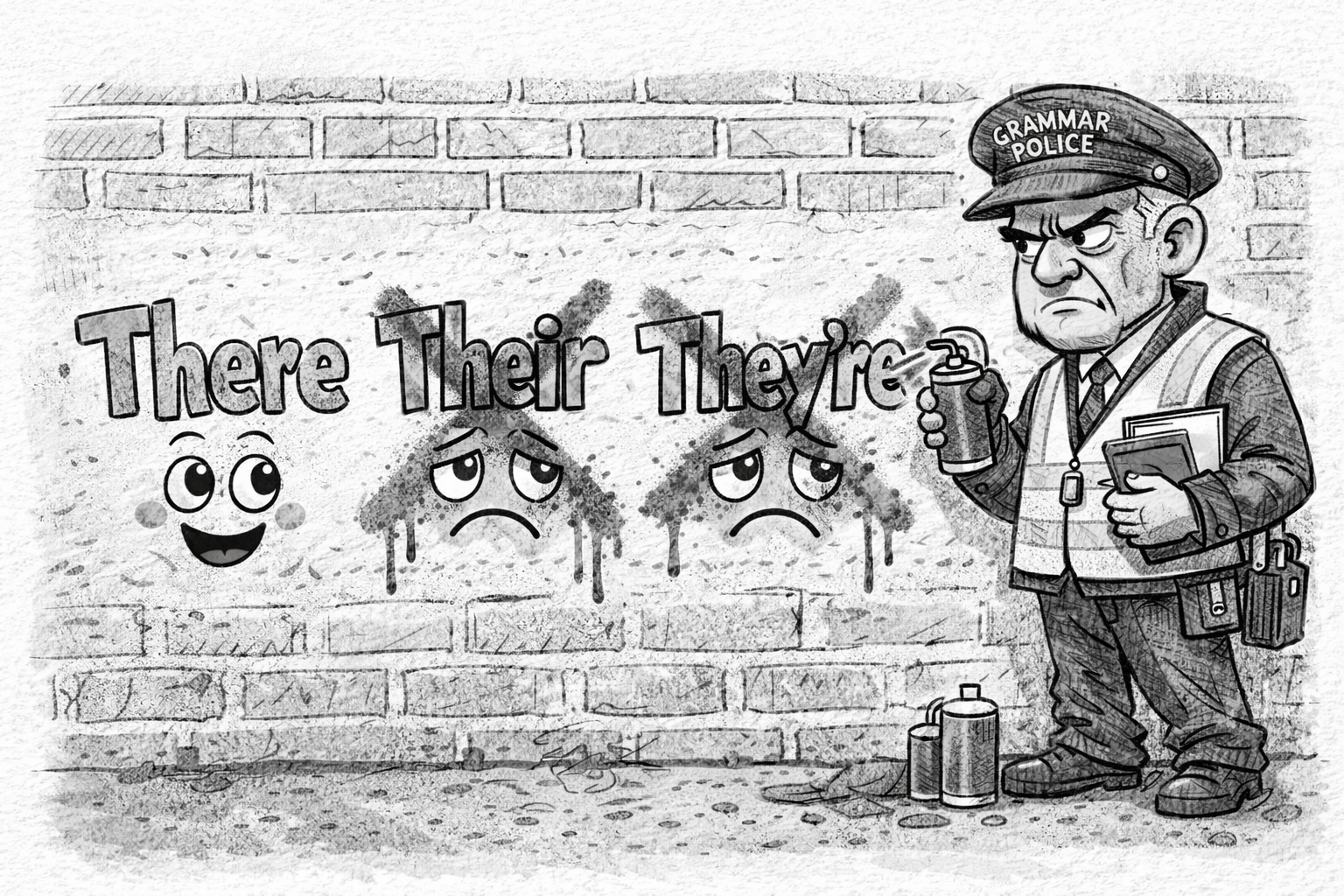
For years, poor grammar functioned as a social marker. Misspellings, clumsy syntax, and inconsistent punctuation were often interpreted not just as technical mistakes, but as indicators of low intelligence, low education, or low status. These misgivings were often highlighted by what became known as the grammar police, countless comments simply stating ‘you’re not your’, regardless of the authors message. The assumption was crude, but socially powerful: poor grammar meant uninformed, while good writing meant a competent mind.
Now something curious has happened.
In many online spaces, especially social media, polished writing is increasingly triggering suspicion. Clear structure, balanced argumentation, and syntactic precision can prompt accusations of artificiality. “This sounds like AI.” “You didn’t write this.” “ChatGPT did this for you.” “AI:DR.”
We have moved from shaming people for bad grammar to shaming people for perfect grammar.
At first glance, this appears to be a cultural reversal. But on closer inspection, it is not a shift in values so much as a redirection of status policing. The underlying social psychological mechanisms remain strikingly similar. What has changed is the target.
This essay explores that shift through the lenses of signalling theory, status defence, authenticity norms, and moral panic. The argument is simple: AI accusations are less about technology and more about protecting social hierarchies in environments that claim to be egalitarian.
Grammar as a Historical Status Signal
Language has always functioned as social currency.
From accent discrimination to vocabulary choice, linguistic style serves as a marker of education, class, and cultural capital. In many societies, grammatical precision became shorthand for intelligence. Schools reinforced this association. Professional spaces rewarded it. Hiring practices privileged it. Personally I recall countless interviews in my youth, where the interviewers ‘gotcha’ question was to get you to explain the differences in there, their and they’re.
The cognitive shortcut was simple:
Clear grammar → disciplined mind → high competence.
This heuristic was never perfectly accurate. Writing skill reflects opportunity, literacy exposure, neurodiversity, and training as much as innate ability. But as a social signal, it worked. It was stable.
Errors, by contrast, triggered status lowering. Poor grammar suggested lack of effort, lack of education, or lack of care. Online culture amplified this. “Grammar policing” became a common tactic in arguments. Correcting someone’s spelling was a way to undermine their credibility without addressing their ideas.
Grammar, in other words, was never just about clarity. It was about hierarchy.
The Disruption: When Fluency Became Ambiguous
Artificial intelligence disrupted the stability of that signal.
Large language models introduced a new possibility: fluency without visible struggle. Structured argumentation without drafts. Polished syntax without years of practice.
Suddenly, good writing no longer reliably indexed high individual ability. It might indicate tool use. It might indicate editing assistance. It might indicate prompt literacy rather than writing fluency.
This creates signal ambiguity.
In social psychology, signals function well when they are costly and hard to fake. When a signal becomes easy to replicate, its social value destabilises. The meaning attached to it becomes contested.
Grammar used to be a costly signal. It required time, education, and practice.
AI lowered the cost.
And when costly signals become cheap, people react.
Social Media and the Performance of Egalitarianism
The reaction is particularly intense on social media, and this is not accidental.
Academic environments openly acknowledge hierarchy. Papers are peer reviewed. Writing is edited. Collaboration is normal. Clarity is rewarded because the goal is knowledge transmission.
Social media, by contrast, performs horizontality. It presents itself as a space of equal voices. Authority is not formally granted but informally negotiated.
In such environments, overt signals of expertise can threaten the illusion of equality. Highly structured writing subtly reintroduces hierarchy. It signals time, cognitive control, and possibly education.
If someone produces a calm, well-structured argument in a heated thread, the contrast becomes visible. That contrast can trigger discomfort.
Accusing someone of using AI serves a social function, it essentially neutralises the threat, and reframes the argument.
Instead of acknowledging the person’s competence, the accusation reframes the competence as artificial. The hierarchy collapses. Status symmetry is restored.
This is status defence, not technological critique.
Authenticity Norms and the Rise of Imperfection
There is another layer to this shift: the cultural elevation of authenticity.
Modern online culture places high value on the unfiltered. Typos, lowercase sentences, abrupt phrasing, and emotional immediacy signal spontaneity. They imply that the speaker is thinking in real time.
Imperfect writing reads as human, whereas polished writing can read as curated, strategic, or engineered.
In authenticity-focused cultures, polish becomes suspect. Effort becomes associated with performance rather than sincerity.
This creates a paradox, the same grammatical precision once interpreted as competence is now sometimes interpreted as inauthenticity.
Importantly, this does not represent a rejection of clarity, it represents a shift in what clarity signals. If clarity feels detached from visible effort, it feels manufactured.
The accusation of AI use is therefore not purely technological. It is moral. It suggests that the speaker has violated an authenticity norm.
AI Moral Panic as Boundary Policing
The reaction to AI also fits classic patterns of moral panic.
Moral panics tend to emerge when:
A new technology disrupts existing norms.
The threat is symbolically amplified.
The boundaries of identity feel unstable.
Heuristics replace careful evaluation.
AI challenges deeply embedded assumptions about authorship and originality. Writing has long been treated as an extension of the self. If machines can replicate writing fluency, what does that mean for intellectual identity?
The anxiety is not just about cheating. It is about displacement.
Calling out AI use becomes a way of policing boundaries. It reinforces the distinction between authentic human cognition and artificial output.
Even when no AI was used, the accusation performs a symbolic act. It reasserts the importance of human effort in a world where effort is harder to detect.
In this sense, AI accusations function like contamination narratives. The fear is not merely deception but impurity.
The Redirect Rather Than the Reversal
It might be tempting to frame this shift as a cultural reversal. But the deeper pattern suggests continuity.
The old mechanism was:
Surface feature → character inference → status adjustment.
Bad grammar triggered negative inferences about intelligence.
The new mechanism is structurally identical.
Good grammar triggers inferences about artificiality.
In both cases, people rely on cognitive shortcuts. The human mind prefers rapid categorisation over nuanced assessment. When confronted with uncertainty, it reduces ambiguity by assigning identity labels.
What has changed is not the existence of status policing but its direction.
The system still punishes deviation from perceived norms.
Previously, deviation meant lack of polish.
Now, in certain contexts, deviation means excess polish.
Effort Visibility and Suspicion
Another critical factor is effort visibility.
Humans intuitively respect visible effort. We are more comfortable with achievement when we can see the struggle behind it. When effort is invisible, achievement can feel undeserved.
AI obscures effort. A well-structured paragraph can be produced in seconds. Observers cannot see whether it took hours of thinking or a single prompt.
This invisibility fuels suspicion, if a piece of writing appears too refined relative to the perceived effort invested, people experience a subtle fairness violation. The accusation of AI restores fairness by attributing the output to automation.
This is not necessarily conscious. It operates at the level of intuitive equity.
When effort is unclear, people often assume the least costly explanation.
Defensive Attribution and Identity Protection
There is also a defensive component.
Writing ability has historically functioned as a domain of pride. For many, it represents years of practice and intellectual development.
If AI can replicate that fluency, it threatens the uniqueness of that skill. One way to reduce that threat is to downgrade AI-assisted writing as inferior or inauthentic.
Accusing others of AI use can therefore serve self-protective purposes. It preserves the perceived value of one’s own effort.
Rather than confronting the destabilising reality that tools can augment cognition, it is psychologically easier to frame polished writing as illegitimate.
In this sense, AI accusations can reflect identity defence more than empirical suspicion.
Why Academia Reacts Differently
Academic spaces appear less reactive for several reasons.
First, academic writing has never been solitary. It is inherently collaborative. Papers are reviewed, edited, and refined. External assistance is normalised.
Second, academia prioritises originality of ideas rather than raw sentence construction. If the argument is coherent and the sources are properly cited, clarity is rewarded.
Third, academic norms already include mechanisms for plagiarism detection and integrity review. The system is structured to manage boundary violations formally rather than socially.
As a result, polish remains positively valued.
In contrast, social media lacks formal integrity systems. Norm enforcement happens through public accusation rather than institutional review.
This difference in governance shapes the emotional tone of reactions.
The Future of Writing as Social Signal
The current tension may represent a transitional period.
Over time, societies adapt to technological change. Calculators did not eliminate mathematics. Word processors did not eliminate writing skill. Instead, standards shifted upward.
It is plausible that AI-assisted writing will become normalised. The signal may move from raw fluency to something else, perhaps depth of insight, originality of perspective, or capacity for synthesis.
When a signal becomes cheap, humans find a new one.
Until that stabilisation occurs, ambiguity will persist. And ambiguity fuels suspicion.
Simply Put: Policing Humanity in the Age of Augmentation
The move from grammar shaming to AI shaming is not a collapse of standards. It is a redirection of social control.
The same cognitive shortcuts, the same status dynamics, and the same boundary enforcement mechanisms are operating under new conditions.
Polished language no longer reliably signals individual competence. It might signal tool literacy. That ambiguity destabilises identity hierarchies in spaces that rely on informal status negotiation.
Accusing someone of using AI is rarely just about detecting automation. It is often about restoring equilibrium.
At its core, the reaction reflects a deeper anxiety: if machines can replicate fluency, what distinguishes us?
The answer will not lie in grammatical imperfection. Nor will it lie in purity tests.
It will lie in how humans integrate tools without surrendering ownership of thought.
In the meantime, the social psychology remains consistent.
We are not witnessing a reversal of judgment.
We are witnessing its re-targeting.
And like all moral panics, it tells us less about the technology itself and more about the insecurities of the culture adapting to it.
Table of Contents