Freud’s Exploration of the Unconscious Mind: An Overview
Sigmund Freud did not invent the idea that parts of the mind operate outside conscious awareness. What he did was place unconscious mental life at the centre of an ambitious theory of personality, distress, conflict, and human behaviour.
For Freud, the mind was not a transparent place in which people calmly inspected their motives and made sensible decisions. It was crowded, divided, and frequently engaged in arguments with itself.
Thoughts could be pushed from awareness. Desires could appear in disguised forms. People could sincerely believe one explanation for their behaviour while being influenced by something quite different.
Freud’s specific theories remain deeply controversial, and many are difficult to test scientifically. Yet the broader proposition that mental activity can occur outside awareness is no longer especially radical. Modern psychology accepts unconscious perception, memory, emotion, and motivation, although these are not necessarily the same thing as Freud’s dynamic unconscious filled with repression and conflict (Westen, 1998).
Freud may not have produced the final map of the mind.
He did, however, make psychologists take the basement seriously.
Freud’s idea of the unconscious
In everyday language, unconscious often means asleep, sedated, or knocked briefly out of proceedings.
Freud meant something different.
The unconscious was a system of thoughts, wishes, memories, impulses, and conflicts that remained outside ordinary awareness while still influencing mental life. Its contents were not simply forgotten information waiting politely to be retrieved. Some material was kept from consciousness because recognising it would create anxiety or conflict (Freud, 1957; Laplanche & Pontalis, 2018).
This is sometimes called the dynamic unconscious. Mental material is unconscious not merely because attention happens to be elsewhere, but because psychological forces prevent it from becoming fully conscious.
Freud argued that unconscious processes could reveal themselves indirectly through dreams, symptoms, fantasies, mistakes, patterns of behaviour, and the therapeutic relationship.
Whether every forgotten name conceals a forbidden desire is another matter. Sometimes a forgotten name is simply what happens when a brain has met too many people.
The larger idea was that people do not always have direct access to the causes of their own behaviour.
The topographical model
Freud’s topographical model divided mental life into three regions: the conscious, preconscious, and unconscious.
These are not literal locations in the brain. They are theoretical ways of describing different relationships to awareness.
The conscious
The conscious contains whatever a person is currently aware of.
This might include a thought, sensation, memory, perception, or feeling occupying attention at that moment. Conscious awareness is immediate but limited. Only a small amount of mental activity can occupy it at once.
You may now be aware of these words, the position of your body, and perhaps the sudden realisation that you have been ignoring an uncomfortable chair for several minutes.
The preconscious
The preconscious contains information that is not currently in awareness but can be retrieved without much difficulty.
A person may not be actively thinking about their postcode, a former teacher’s name, or what they ate yesterday. The information can nevertheless be brought into consciousness when needed.
The preconscious therefore sits between immediate awareness and material that is psychologically inaccessible.
The unconscious
The unconscious contains mental processes and material that cannot be accessed simply by deciding to think about them.
Freud believed that unacceptable wishes, painful conflicts, and threatening memories could be kept outside awareness through repression. They might nevertheless influence emotion and behaviour or appear indirectly in disguised forms (Freud, 1957).
The topographical model is often illustrated using an iceberg, with consciousness above the water and a much larger unconscious region beneath it.
It is a useful classroom image.
Freud himself does not appear to have used it in his published work, which has not stopped the iceberg from enjoying an extremely successful career in introductory psychology.
Repression and unconscious conflict
Repression is central to Freud’s theory of the unconscious.
It refers to the process through which threatening or unacceptable mental content is kept from conscious awareness. Freud did not view repression as a deliberate choice. A person does not calmly examine a thought, file it under “absolutely not,” and continue with their afternoon.
The process is unconscious.
The difficulty is that repressed material does not necessarily disappear. Freud believed it could continue exerting psychological pressure, contributing to anxiety, symptoms, dreams, or repeated patterns of behaviour (Freud, 1957).
This made psychological symptoms meaningful within psychoanalytic theory. A symptom was not simply a malfunction. It could represent a compromise between an impulse seeking expression and a defence trying to prevent it.
That is an elegant idea.
It is also difficult to test, because almost any outcome can potentially be interpreted as evidence of hidden conflict. If a person remembers something, it matters. If they do not remember it, perhaps repression matters. A theory capable of explaining every possible outcome can become impressively difficult to prove wrong.
The structural model
Freud later developed a different way of describing the mind: the structural model of the id, ego, and superego.
This model did not simply replace the topographical one. The two address different questions. The topographical model concerns levels of awareness, while the structural model concerns competing psychological functions (Freud, 1961; Laplanche & Pontalis, 2018).
Importantly, the ego and superego are not entirely conscious. Parts of both can operate unconsciously.
Psychology diagrams often present the three structures as tiny people arguing inside the skull. Freud’s theory was more complicated, although admittedly less convenient to fit into a triangle.
The id
The id represents instinctual drives and demands.
It operates according to the pleasure principle, seeking immediate satisfaction and relief from tension. It does not care particularly about social rules, long-term consequences, or whether tomorrow’s version of you will have to explain what happened.
The id is impulsive, demanding, and entirely unconscious.
Hunger, aggression, sexuality, and other basic drives were central to Freud’s account, although his particular drive theories changed across his career (Freud, 1961).
The ego
The ego develops in relation to reality.
It attempts to satisfy the id’s demands in ways that take account of the external world, consequences, social expectations, and safety. This is known as the reality principle.
The ego therefore negotiates.
It manages demands from the id, restrictions from the superego, and the inconvenient fact that reality rarely reorganises itself around immediate desire.
The ego is not simply the rational or good part of the personality. It can distort reality, deploy defences, and operate unconsciously. Its job is management, not moral perfection.
The superego
The superego represents internalised values, prohibitions, ideals, and moral standards.
It develops partly through identification with parents and wider social expectations. It can produce pride when a person lives up to an ideal and guilt or shame when they fall short.
The superego is sometimes treated as a wise internal conscience. Freud’s version could also be severe, punitive, and unreasonable.
It is less a calm ethical adviser and more an internal critic who has occasionally mistaken perfectionism for public service.
Id, ego, and superego in practice
Imagine someone trying to stick to a diet while being presented with an impressive slice of cake.
The id wants the cake immediately.
The superego may respond with rules, guilt, and stern commentary concerning discipline.
The ego considers the situation. It may refuse the cake, eat it, choose a smaller portion, plan around it, or spend several minutes pretending not to notice the cake while thinking about nothing else.
Freud argued that behaviour often emerges from negotiations between competing wishes, moral demands, anxiety, and reality (Freud, 1961).
Psychological distress may arise when these conflicts become intense or when the ego cannot manage them effectively.
The cake is rarely just the cake in psychoanalysis.
Sometimes, to be fair, it probably is.
Defence mechanisms
Defence mechanisms are unconscious psychological processes used to manage anxiety, conflict, and threatening thoughts or feelings.
Freud introduced several defensive processes, but his daughter Anna Freud organised and expanded the account of how the ego protects itself from distress (Freud, A., 2018).
Defences are not necessarily signs of illness. They can be ordinary and temporarily useful. Problems arise when they become rigid, excessive, or prevent a person from recognising reality.
Repression
Repression keeps distressing or unacceptable material outside conscious awareness.
This is not ordinary forgetting. Within psychoanalytic theory, the material is excluded because acknowledging it would produce conflict or anxiety.
Denial
Denial involves refusing to acknowledge an aspect of reality that is too threatening or painful.
A person may behave as though a diagnosis, loss, addiction, or relationship problem is not real despite substantial evidence.
Projection
Projection involves attributing one’s own unacceptable feelings or impulses to someone else.
A person struggling with hostility may become convinced that everyone around them is hostile toward them.
Displacement
Displacement redirects an emotion or impulse from its original target toward a safer one.
Someone unable to express anger toward their employer may return home and become furious because a cupboard door has displayed insufficient respect.
Rationalisation
Rationalisation supplies a plausible explanation that conceals a more uncomfortable motive.
The explanation may sound logical while protecting the person from examining disappointment, envy, fear, or responsibility.
Sublimation
Sublimation channels an unacceptable impulse into a socially acceptable or productive activity.
Freud regarded this as a relatively mature defence because the underlying energy is redirected rather than simply denied.
Defence mechanisms are useful concepts partly because they capture something familiar: people are often creative in the ways they avoid knowing what they know.
The scientific challenge is determining when a defence has genuinely been identified rather than inferred after the fact.
Freud’s continuing influence
Freud’s influence extends far beyond whether psychologists accept the id, Oedipus complex, or his particular theory of dreams.
He helped establish several ideas that became central to later psychodynamic thought:
mental activity can occur outside awareness;
behaviour may reflect competing motives;
people can be ambivalent;
early relationships can influence later patterns;
psychological symptoms may have meaning;
the therapeutic relationship can reveal recurring interpersonal expectations.
Later psychoanalytic thinkers revised, rejected, or substantially rebuilt much of Freud’s system. Object relations theory, ego psychology, attachment-informed psychoanalysis, self psychology, and relational psychoanalysis often differ sharply from Freud’s original drive-based model (Mitchell & Black, 2016).
Psychoanalysis did not remain frozen in Vienna waiting for everyone else to catch up.
It argued with Freud almost immediately and has been doing so ever since.
Does modern psychology support Freud?
The answer depends on which Freud is being discussed.
Modern research strongly supports the broad idea that much mental processing occurs outside conscious awareness. Perception, memory, emotional evaluation, habits, goals, and social judgements can all be influenced by processes people cannot fully report (Westen, 1998).
That does not prove Freud’s complete theory.
Evidence for unconscious information processing does not automatically confirm repression, psychosexual stages, dream symbolism, or the structural model. Freud’s unconscious was dynamic, motivational, and shaped by conflict. The modern cognitive unconscious is often described through automatic processing, implicit memory, attention, and learned associations.
There is overlap, but not identity.
Saying “Freud was right because unconscious processing exists” is rather like saying an early mapmaker was entirely correct because the continent was indeed there.
The broad territory mattered.
Many of the roads still needed redrawing.
Criticisms of Freud
Freud’s work has faced substantial criticism.
Difficulty testing the theory
Many psychoanalytic claims are difficult to falsify.
The id, ego, and superego cannot be directly observed. Interpretations of repression, symbolism, and unconscious conflict can be flexible enough to explain very different outcomes.
This creates the risk of circular reasoning. A person’s behaviour is attributed to an unconscious conflict, and the existence of the conflict is then inferred from the same behaviour.
Freud developed many of his ideas through clinical case studies rather than controlled research. Those cases were rich in detail but limited as evidence for universal theories of human development.
Cultural assumptions
Freud’s theories emerged from a particular historical and social setting.
His models often reflected European middle-class family structures, sexual norms, gender roles, and assumptions about authority. Concepts presented as universal may therefore describe a narrower cultural world than Freud recognised.
Later psychoanalytic traditions increasingly considered relationships, culture, social context, attachment, and interpersonal experience rather than explaining personality primarily through instinctual drives (Mitchell & Black, 2016).
Gender and sexuality
Freud’s accounts of women and female development have been heavily criticised.
Some claims treated male development as the standard and female development as a deviation requiring explanation. His theories of sexuality were radical in acknowledging childhood sexuality and unconscious desire, but they also carried assumptions that now appear restrictive, speculative, or plainly wrong.
Historical importance does not require continued agreement.
Psychology is allowed to inherit an idea without keeping all the furniture.
The problem of interpretation
Psychoanalytic explanations can encourage overinterpretation.
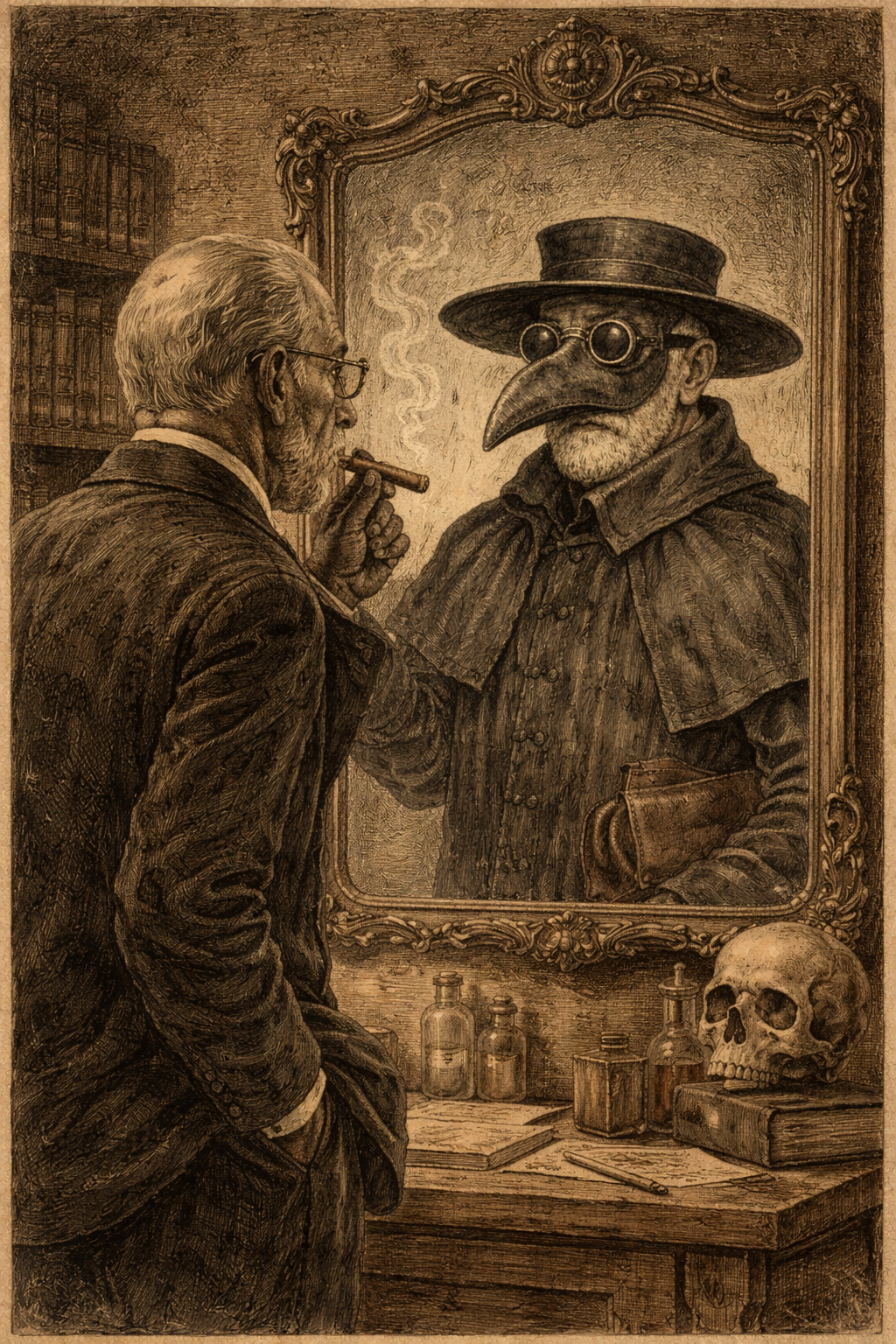
A dream, mistake, joke, preference, or hesitation may be treated as evidence of hidden meaning. Sometimes that produces useful insight. Sometimes a cigar is merely attempting to complete its brief career as a cigar.
The interpretive richness of Freud’s theory is part of its appeal.
It is also one of the reasons scientific evaluation is difficult.
Simply Put
Freud placed unconscious mental life at the centre of his theory of human behaviour.
His topographical model distinguished between the conscious, preconscious, and unconscious. His later structural model described the id, ego, and superego as competing systems involved in desire, reality, and morality.
Defence mechanisms explain how the mind may protect itself from anxiety and conflict by repressing, denying, projecting, displacing, rationalising, or redirecting uncomfortable material.
Many of Freud’s specific claims lack strong scientific support. His theories were shaped by the culture in which he worked, relied heavily on interpretation, and often resisted straightforward testing.
Yet Freud’s larger challenge remains important: people are not always fully aware of why they think, feel, or behave as they do.
Modern psychology studies unconscious processing very differently, but it has not returned to the comforting idea that consciousness is entirely in charge.
Freud’s map was speculative, crowded, and occasionally drew sea monsters where evidence should have been.
But he was right that there was more beneath awareness than people liked to admit.
References
Freud, A. (2018). The ego and the mechanisms of defence (C. Baines, Trans.). Routledge. (Original work published 1936). https://doi.org/10.4324/9780429481550
Freud, S. (1957). The unconscious. In J. Strachey (Ed. & Trans.), The standard edition of the complete psychological works of Sigmund Freud (Vol. 14, pp. 159–215). Hogarth Press. (Original work published 1915).
Freud, S. (1961). The ego and the id. In J. Strachey (Ed. & Trans.), The standard edition of the complete psychological works of Sigmund Freud (Vol. 19, pp. 1–66). Hogarth Press. (Original work published 1923).
Laplanche, J., & Pontalis, J.-B. (2018). The language of psychoanalysis. Routledge. https://doi.org/10.4324/9780429482243
Mitchell, S. A., & Black, M. J. (2016). Freud and beyond: A history of modern psychoanalytic thought (Updated ed.). Basic Books.
Westen, D. (1998). The scientific legacy of Sigmund Freud: Toward a psychodynamically informed psychological science. Psychological Bulletin, 124(3), 333–371. https://doi.org/10.1037/0033-2909.124.3.333
Table of Contents