The Psychology of Count Binface: Why the Joke Candidate Takes Democracy Seriously
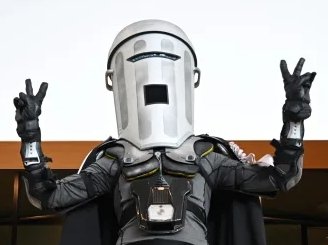
Count Binface treats political theatre as a joke because democracy is not one. Beneath the bin is a psychologically sophisticated form of satire—one that uses absurdity to puncture political performance, convert frustration into participation and remind voters that solemnity is not the same thing as seriousness.
British election night occasionally produces an image that would seem implausible anywhere else: a prime minister standing beneath the fluorescent lights of a leisure centre beside an intergalactic warrior wearing a silver bin on his head. The returning officer reads each name with equal formality. The mainstream candidate attempts to look statesmanlike. Count Binface waits patiently for the democratic will of Earth to be declared.
The immediate joke is visual. The deeper joke takes longer to arrive.
Count Binface looks absurd, but often speaks about democracy with greater clarity and affection than many supposedly serious politicians. His manifestos combine prohibiting loud snacks in theatres with tying ministers’ salaries to nurses’ pay. He promises to restore Ceefax, but also to build “at least one affordable house”—a joke whose deliberately pathetic ambition exposes decades of grander housing promises that have produced too little. He does not trivialise politics by introducing nonsense into it. He introduces carefully constructed nonsense to reveal how much nonsense was already there.
His method rests on a paradox: do not take political performance seriously, so that people might begin taking democracy seriously again.
The Most Serious Man in the Room Is Wearing a Bin
Count Binface is the creation of comedy writer and producer Jon Harvey, who previously appeared as Lord Buckethead before developing his own character. Harvey has worked on British political comedy including The Thick of It and Have I Got News for You. His campaigns have placed him opposite Boris Johnson, Rishi Sunak and other prominent politicians, usually under the most unflattering lighting available to British municipal architecture.
The electoral numbers are modest in conventional terms but substantial for what could easily have remained a one-night joke. Binface received 24,775 first-preference votes in the 2021 London mayoral election and another 24,260 votes in 2024. In the latter contest, he finished ahead of Britain First’s candidate. He also received 190 votes in the 2023 Uxbridge by-election, 308 against Rishi Sunak in the 2024 general election and 95 in the 2026 Makerfield by-election.
Nor is recognition confined to election-night enthusiasts. An Ipsos poll conducted during the 2024 general election campaign found that 16% of British adults viewed Binface favourably. Among 18- to 34-year-olds, the figure was 31%, compared with 16% for then-prime minister Rishi Sunak. Most respondents still knew little about the character, so the poll should not be mistaken for evidence of a mass political movement. It does show, however, that Binface had developed a recognisable public identity rather than remaining an obscure private joke.
His return to prominence in July 2026 sharpened the psychological contrast. When Nigel Farage triggered a by-election in Clacton and the principal mainstream parties declined to participate, Binface announced that he would stand. This briefly created the prospect of a contest in which the candidate wearing an obvious costume was confronting a political environment saturated with claims of authenticity, betrayal, persecution and anti-establishment rebellion.
Yet the most revealing statement of Binface’s ethos appeared during the earlier Makerfield contest:
“Whoever you vote for, VOTE. Democracy is a rare and precious thing.”
The surrounding material included jokes about Wimpy restaurants, Wigan kebabs and intergalactic domination. But the appeal itself was sincere. People were urged to attend the polling station, participate in the process and resist those seeking to degrade democracy. That is not political nihilism. It is civic commitment communicated through a bin-shaped delivery system.
The Return of the Licensed Fool
Count Binface occupies the cultural role of the licensed fool: the ridiculous figure permitted to say what respectable figures cannot.
The court jester is often romanticised as the one person who could tell a king the truth without losing his head. The historical reality was more complicated, and not every fool enjoyed such protection. Nevertheless, the jester remains a powerful social archetype: a low-status or deliberately undignified character who uses humour, inversion and apparent foolishness to expose the folly of those above them (Otto, 2015).
Binface recreates that relationship within democratic politics. By wearing the bin, he abandons the conventional contest for dignity. He cannot credibly present himself as a polished statesman, serious technocrat or commanding national patriarch. That apparent weakness gives him an unusual freedom. Because he possesses no conventional prestige to defend, he can puncture the prestige performances of everyone around him.
This explains why the costume matters. Without it, Harvey would be another satirist criticising political hypocrisy. Inside it, he becomes a symbolic intruder. The bin standing beside a prime minister changes the visual meaning of the stage. It reminds the audience that electoral status is temporary, political grandeur is constructed and the supposedly elevated candidate must ultimately stand in the same queue as everyone else while the votes are counted.
Binface’s earlier campaign literature captured the reversal neatly: politicians had “made a mockery of politics”; now it was his turn. The line works because it relocates the absurdity. The man in the bin is not claiming that democracy is inherently ridiculous. He is suggesting that dishonesty, incompetence and empty promises have already made politics ridiculous—and that an honest joke may be the appropriate response.
Why the Joke Works
Most humour theories begin with some form of mismatch. We anticipate one thing and encounter another. A formally administered election is expected to display seriousness, order and civic dignity. Count Binface violates that expectation simply by arriving.
Incongruity alone, however, is not always funny. A violation can be disturbing, offensive or threatening. McGraw and Warren’s (2010) benign violation theory proposes that humour emerges when something appears wrong or improper while also being experienced as sufficiently safe, acceptable or psychologically distant. The audience must perceive both the violation and its harmlessness at approximately the same time.
Binface produces almost laboratory-grade benign violation. He violates the expected dignity of political office, but does not appear to threaten the democratic process. On the contrary, he follows its rules, pays the deposit, produces a manifesto, appears at the count and repeatedly encourages people to vote. He is absurd within democracy rather than hostile towards it.
This distinction allows his criticism to pass through psychological defences that might reject a conventional political lecture. Direct attacks on a party or politician immediately activate identities: supporter or opponent, left or right, insider or outsider. The joke initially asks for something easier—a moment of amused recognition. By the time the political criticism becomes clear, the audience has already entered the frame.
The strongest Binface policies therefore operate on two levels. Banning speakerphones in public is comic because it inflates a minor irritation into a matter of government. Tying ministers’ pay to nurses’ pay reverses the technique: it uses the same manifesto to direct attention towards political incentives and public-sector value. “Build at least one affordable house” sounds laughably inadequate, but its inadequacy is the accusation.
The policy is not funny because housing is unimportant. It is funny because housing is so important that decades of solemn promises have become difficult to distinguish from parody.
The Honest Mask
Count Binface also presents an intriguing problem for political authenticity. He is transparently artificial, yet that artificiality may make him appear unusually honest.
Political authenticity is not the absence of performance. Politicians cannot present an unmediated “true self” to millions of strangers. They select stories, gestures, clothing, settings and language to construct a public persona. Luebke (2021) therefore describes political authenticity as a social construction produced between politicians, media and audiences. Perceptions of authenticity are shaped by qualities such as consistency, immediacy, ordinariness and the apparent relationship between public performance and private identity.
Binface’s peculiar advantage is that he never denies the performance. No reasonable observer believes that he is literally a thousands-of-years-old intergalactic warrior from Sigma IX. The audience is not being deceived; it is being invited into a shared fiction. The artifice is visible, acknowledged and stable.
Conventional politicians often perform spontaneity while asking audiences to believe that no performance is occurring. Carefully selected kitchen photographs, apparently casual videos and strategically disclosed personal stories are presented as glimpses behind the political mask. Binface reverses the arrangement. He puts on the most conspicuous mask imaginable and then communicates a remarkably consistent set of values through it.
This creates what might be called authenticity of intention. The character is fictional, but the purpose of the character is legible. Binface wants to ridicule pomposity, expose failures and celebrate participation. His exaggerated artificiality makes the communicative contract clearer: this appearance is constructed, and we both know it. Paradoxically, that can feel more truthful than a highly managed politician insisting that the camera has simply caught them being natural.
The bin is therefore not merely a disguise. It is a commentary on disguise.
Turning Helplessness into Ridicule
Modern politics generates emotional overload. Citizens are repeatedly exposed to scandals, crises, threats and apparently insoluble problems. When people feel that they possess little control, political attention can become exhausting. Withdrawal, fatalism and cynical detachment are understandable responses.
Humour can create enough psychological distance for people to look again. It reframes the political object without denying its existence. Instead of asking audiences to remain permanently anxious or furious, satire allows them to approach the issue through recognition and laughter.
This does not necessarily neutralise anger. Research suggests that political satire can sometimes channel negative emotion into participation. In an experiment involving political cartoons and electoral reform in Hong Kong, Chen, Gan and Sun (2017) found that counter-attitudinal satire could increase intentions to participate in issue-related activities by evoking anger, particularly among people who considered the issue personally important. The authors also emphasised that the wider evidence is mixed: satire may encourage discussion and efficacy, but it can also foster cynicism and alienation.
Count Binface’s satire is effective partly because it converts anger into ridicule. Anger can unintentionally magnify its target, confirming that the powerful figure is dangerous, commanding and worthy of intense attention. Ridicule attacks status itself. It makes displays of grandeur appear needy and pretension appear fragile.
This is especially disruptive to political styles built upon dominance. The strong leader wishes to be feared, admired or treated as the only adult capable of controlling chaos. Binface does not attempt to defeat that performance through a rival display of strength. He places a bin next to it.
The resulting contrast can reverse the status hierarchy. The candidate seeking reverence becomes the straight man. The supposed fool controls the joke.
The Protest Vote as a Democratic Message
A vote for Count Binface is unlikely to be based on the belief that he will implement intergalactic dominion or successfully nationalise Adele. That does not make the vote psychologically empty.
Voting is both instrumental and expressive. Instrumentally, people vote to influence who gains office. Expressively, they communicate identity, approval, rejection or dissatisfaction. A ballot can say: I support this candidate, but also I reject the available hierarchy, I wanted my objection counted or I participated without granting any mainstream candidate my consent.
Research on protest voting warns against assuming that all such voters are motivated by undifferentiated rage. Birch and Dennison (2017) found that protest choices are shaped not only by distrust, but also by policy preferences, campaign communication and the characteristics of the available outsider options. They concluded that protest voting remains a political act rather than merely a symptom of discontent.
The same caution applies to Binface. His voters cannot be assigned a single psychological profile from aggregate election results. Some may enjoy the comedy. Some may object to mainstream candidates. Some may favour particular satirical policies. Others may appreciate the character’s defence of democracy or simply wish to ensure that an extremist candidate finishes lower.
What distinguishes the Binface vote from passive disengagement is that the voter still turns up. The dissatisfaction becomes visible, countable and attributable. Abstention can mean protest, but it can also mean illness, inconvenience, indifference or administrative exclusion. A vote for a satirical candidate leaves a clearer message:
I saw the political spectacle. I understood the available choices. I participated—and this is what I chose to say.
When Satire Becomes a Sedative
There is, however, a danger in celebrating political humour too easily.
Laughter can restore agency, but it can also imitate it. A person may share a joke, experience a moment of relief and feel that something has been accomplished even when no material action follows. Satire can become an emotional release valve: pressure escapes, the audience feels temporarily less helpless and the underlying structure remains untouched.
Humour can also make dangerous figures seem merely entertaining. When misconduct is repeatedly converted into amusing clips and impressions, the politician may become a familiar comic character rather than a source of consequences. Ridicule can puncture power, but it can also reduce genuine threats to content.
International comparisons demonstrate the uncertain boundary between satire and political power. In the United States, perennial candidate Vermin Supreme has used a boot-shaped hat and promises of free ponies as political performance. In Italy, comedian Beppe Grillo travelled much further along the same spectrum: his anti-establishment Five Star Movement received approximately 26% of the vote in the 2013 general election and became a major national force. Satirical outsider politics can remain symbolic, but it can also transform into populist organisation and eventually acquire the powers it once mocked.
Count Binface has so far avoided claiming that comedy alone constitutes a programme for government. His campaigns remain anchored to participation rather than personal salvation. The repeated instruction to vote—even for someone else—is important because it reconnects the joke to democratic behaviour.
That may be the dividing line between satire that mobilises and satire that sedates. Effective political satire does not merely make the audience feel clever for recognising absurdity. It points beyond the punchline. It identifies a value, an injustice, a decision or an action that still matters when the laughter ends.
A Very British Bin with a Global Function
Count Binface belongs to a distinctively British electoral tradition, but the psychology is not uniquely British. Every political system develops rituals intended to make power appear natural: motorcades, podiums, flags, carefully controlled interviews, official language and hierarchies of access. Satirical figures interrupt those rituals and reveal them as performances rather than facts of nature.
This matters because political power relies partly on psychological distance. Leaders appear elevated, systems appear permanent and ordinary citizens appear small. The fool reduces that distance. By entering the official ceremony without adopting its emotional rules, the satirist demonstrates that authority can be observed, questioned and laughed at.
Yet Count Binface’s satire is not fundamentally anti-institutional. He does not stand outside the election declaring the entire process fraudulent or meaningless. He fills in the forms, submits to the count and celebrates the right of his opponents to participate. His humour profanes political grandeur while preserving democratic procedure.
That combination is increasingly rare. Contemporary anti-establishment politics often asks citizens to express distrust by placing greater faith in a charismatic individual. Binface asks citizens to distrust political pomposity while continuing to value the system that lets them reject him.
He is anti-reverence, not anti-democracy.
Simply Put
Count Binface is funny because he wears a bin on his head. He matters because the bin is often not the most artificial thing on the stage.
His costume exposes the theatricality of politics. His foolishness creates permission to speak plainly. His policies use incongruity to redirect attention towards real failures. His candidacy offers dissatisfied voters an expressive form of participation. Most importantly, his humour contains an earnest civic message: democracy may be shabby, frustrating and frequently absurd, but it remains worth turning up for.
The central distinction is therefore not between serious candidates and joke candidates. It is between solemnity and seriousness.
Solemnity is a style. It uses formal language, controlled expressions and carefully rehearsed concern. Seriousness is a relationship to consequences. It asks whether promises matter, whether institutions function, whether ordinary people are heard and whether those who seek power can be held accountable.
Count Binface abandons solemnity in order to recover seriousness.
The joke is not that democracy permits a man in a bin to stand for election. The joke is that the man in the bin sometimes appears to understand democracy better than the people asking us to treat them with reverence.
Count Binface treats political theatre as a joke because democracy is not one.
References
Birch, S., & Dennison, J. (2017). How protest voters choose. Party Politics. https://doi.org/10.1177/1354068817698857
Count Binface. (2021). London Mayor 2021.
Count Binface. (2026). Dear Makerfield.
Greater London Authority. (2021). Final results: Election of the Mayor of London.
Green, G. (2023, October 31). The man behind Count Binface. Prospect.
Ipsos. (2024, June 22). One in six Britons are favourable towards Count Binface.
Luebke, S. M. (2021). Political authenticity: Conceptualization of a popular term. The International Journal of Press/Politics, 26(3), 635–653. https://doi.org/10.1177/1940161220948013
McGraw, A. P., & Warren, C. (2010). Benign violations: Making immoral behavior funny. Psychological Science, 21(8), 1141–1149. https://doi.org/10.1177/0956797610376073
Otto, B. (2015). The court jester is universal…but is he still relevant? Management and Organization Review, 11(3), 559–573. https://doi.org/10.1017/mor.2015.41
Taylor, P. (2013, March 11). Italy’s Grillo blazes trail for Europe’s populists. Reuters.
Table of Contents